Saturday, June 6, 2026

The Day I Lost A Prisoner

Early on in my career (before I ever thought I was going to have a career in the Navy), I made a rookie mistake. It’s the only “sea story” I’ve included in the book I am writing.  It went something like this:  

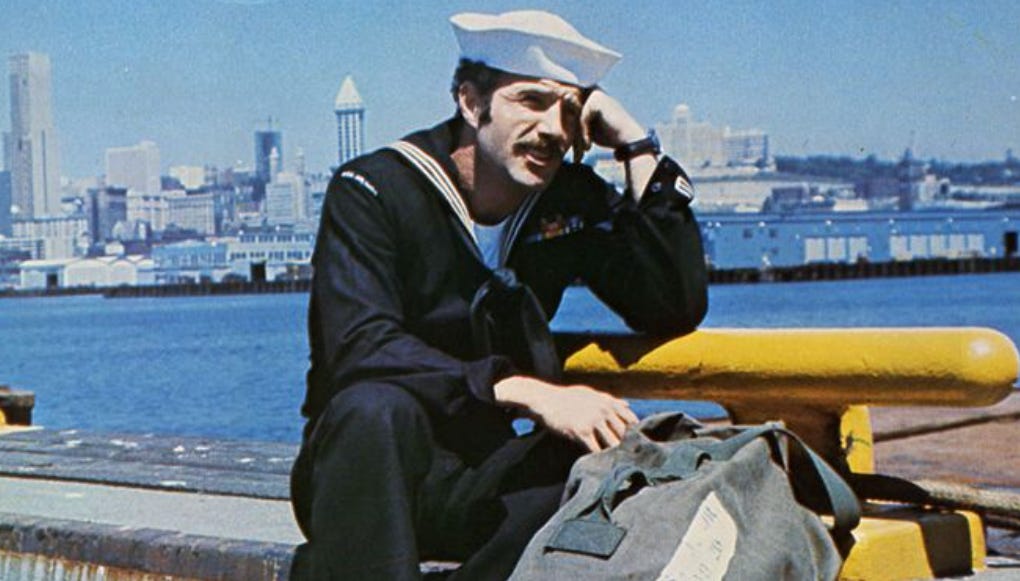
Nearly 100 years ago, when I was an Ensign at my first duty assignment, I lost a prisoner. Or maybe it was the Chief that lost the prisoner. In any case, let’s say for this argument’s sake that “we” lost our prisoner - The Mulch.

In the 1980’s, the (illegal for American consumption/purchase) Japanese cough suppressant ‘bron’ was very popular among young Sailors due to its unrestricted availability, low cost and perceived low rate of detection. One of our stellar Second Class Petty Officers succumbed to the temptation of a cheap and easy high and was caught in a routine urinalysis sweep of our detachment’s Sailors. Captain’s Mast resulted in a reduction from E5 to E3, a fine and 30 days in Correctional Custody. ((NOTE: CC is the most serious deprivation of liberty authorized as a punishment under the Uniform Code of Military Justice, article 15. Uniform Code of Military Justice, article 15 is designed to be a means of disposing of minor infractions of discipline without having to stigmatize a service member with a court-martial (felony) conviction.)) Administratively, he lost his security clearance, flight orders and was detailed to general duty as a Seaman aboard ship. Funny that as CTs, we thought orders to a ship was punishment for a Sailor.

Our awardee was about to be released from Yokosuka Naval Base’s Correctional Custody Unit (Correctional Custody Unit) and we (the Chief and I) were being briefed on the ‘rules of the road’ by our Officer in Charge. ((NOTE: CC is the most serious deprivation of liberty authorized as a punishment under the Uniform Code of Military Justice, article 15. Uniform Code of Military Justice, article 15 is designed to be a means of disposing of minor infractions of discipline without having to stigmatize a service member with a court-martial conviction.))

The Officer in Charge’s ‘rules of the road” were to be:

Rule 1. Prisoner will make no phone calls.

Rule 2. Prisoner will eat no meals.

Rule 3. Prisoner will not be allowed to shower or shave.

Rule 4. Prisoner will not be allowed a change of clothes.

Rule 5. Prisoner will never be out of sight (even in the head (toilet).

Rule 6. Prisoner will not smoke.

Now, even after 30+ years of analysis, I can’t say for certain which violation of these rules led to the prisoner’s escape. But, he did escape.

With the ‘rules of the road’ fully explained and understood, the Chief and I made our way in the command vehicle from Atsugi, Japan down to the Yokosuka Naval Base Correctional Custody Unit via Route 16. Recovering our “awardee” (once a stellar PO2 and now a Seaman) from Correctional Custody Unit was quite an experience. They had broken him down to his least survivable component. I should say that Correctional Custody Unit of 1983 and Correctional Custody Unit of today are two VERY DIFFERENT animals. When he went into Correctional Custody Unit 30 days prior, he had been stripped of all his clothing and walked around the circular Correctional Custody Unit cell area, searched and then placed in a holding cell. Quite a traumatic experience for our former Sailor of the Quarter and for me, a brand new Ensign. These behaviors are prohibited now but were standard practice then:

·      Requiring awardees to salute enlisted personnel or address them as sir/ma’am.

·      Requiring awardees to face the bulkhead at close range when a staff member passes.

·      Requiring awardees to request permission to speak when there is no valid reason for the requirement.

·      Requiring permission to move normally within spaces when not engaged in formal activities.

·      Requiring silence as a routine condition.

The Chief and I signed for our awardee and began our trip to Narita International Airport to put our awardee on a commercial flight to the U.S. so he could join his ship in San Diego. He was a broken young man, in need of a shower, shave, change of clothes and a hot meal - all prohibited by the Officer in Charge in his ‘rules for the road’. As we headed for the airport, we made an unexpected (by me) detour back to Atsugi on Route 16. The Chief said he had forgotten something at home and needed to grab it before heading to Narita.

Once at the Chief’s home in Atsugi, we all went in where we were greeted by the Chief’s very gracious wife who invited us into the kitchen for breakfast, which was already well underway - violation of rule #2. Our awardee had not eaten for more than 15 hours at this point. After the meal, the Chief sent The Mulch to take a shower and shave in the back bathroom and to put on his dress blues (violation of rules 3, 4 and 5). We had maintained strict adherence to rules 1 and 6 for more than two hours. We were strong on 1 and 6.

The Mulch thanked the Chief’s wife for breakfast and then we headed out for the airport. We made it there in about 2 hours and had not broken any more rules. We checked in at the UNITED AIRLINES counter with The Mulch and check-in counter attendant engaging in a lively conversation in fluent Japanese. The Mulch had immersed himself in Japanese culture during his tour in Japan and was leaving behind a Japanese fiancé that he had not seen or spoken to in 35 days and who was several months pregnant with their little girl.

With the check-in complete, we were about 90 minutes from seeing our awardee get on a plane and head to his new assignment as a deck Seaman aboard USS MONTICELLO (LSD-35). We stored his seabag in a locker, stopped at a phone bank so he could let his fiancé know that he was departing the country and would not see her for some time. Again, he spoke fluent Japanese and we didn’t have a clue how his conversation went. We could only assume there was plenty of crying on the other end.

Then we began the wait for departure at Bob’s Big Boy restaurant on the second level of the terminal area. The Chief, The Mulch and I had lunch (Why not, we had already violated rule #2; once broken there was no fixing it.) The Mulch toyed with his lighter and cigarettes but the Japanese were enforcing rule #6 and this is the one rule which would remain intact for the entirety of this story. As one would expect over a 6 hour period, The Mulch needed to go to the head. Rule #5 reared its ugly head. The Mulch was not to be left alone, not even to go to the head. I suggested the Chief go with him. The Chief suggested that we could both see the door to the head and could keep an eye on it from the table. After all, where was The Mulch going to go? He had already checked in and confirmed for the flight to Los Angeles For Further Travel to San Diego.

After a lengthy period, I became nervous that The Mulch had not returned from the head (though his VALUABLES - $4 pack of cigarettes, $2 lighter and $8 Casio watch were still at the table). I’d had enough of the rule breaking, I was going in to the head and lay down ‘the rules of the road’. I didn’t see The Mulch at any of the urinals and all the stalls were empty except one. Thank goodness, there was still a chance he was in that stall. I called out his name. No answer. I called it out again. No answer. I banged on the stall door. No answer. I climbed on the toilet in the adjoining stall to look over into the last stall. A poor Japanese gentleman was cowering on the toilet looking up at the LUNATIC Ensign. Our prisoner had escaped !!

I went back out to the table to let the Chief know, we had lost our prisoner. He said, “You know sir, the Officer in Charge put you in charge of this detail.” Inside the Chief was laughing the laugh that only a Chief can laugh. “Well sir, you’d better call the Officer in Charge and let him know The Mulch is gone.”

I made the call to the Officer in Charge.

- Me - “Sir, The Mulch is gone”

- Officer in Charge - “Glad I could send you and the Chief and get the job done. Good job.”

- Me - “No, sir, I mean he took off. He’s gone.”

- Officer in Charge - “You’re calling because he assaulted you and the Chief, and then took off?”

- Me - “No, sir, I’m calling because he went to the head and went out the back door.”

- Officer in Charge - “Mad Dog Murphy, the XO is not going to be happy to hear about this from you tomorrow when you get back. Grab the Chief and come back to Atsugi.”

That was a long drive back to Atsugi. There were about two dozen leadership lessons in there and the story has been told many times over.

The Mulch made it to his ship on time. We had no authority over him after he did his time in Correctional Custody Unit. There were no ‘rules of the road’. The Chief did everything right that day for the Sailor and the Navy. The Officer in Charge had no bad words for us upon our return. The XO feigned outrage over our loss of the prisoner. The Chief knew better. He restored that young man’s dignity from the first moment of contact with him and he taught me lessons all day long and for many months to come at that little detachment in Atsugi, Japan. I was the butt of many a JO joke and paid many tabs at the O Club where my shipmates left their $4 cigarettes and $2 lighters as ‘collateral’ when they left $40 checks at the table.

The Mulch told his girlfriend on the phone that he was at Narita but would be “home” soon for a few days before he’d have to fly to San Diego to join his ship. He told the ticket counter attendant not to check him in that day and that he’d be back for a later flight. All of this was unknown to us because we hadn’t immersed ourselves in the culture as he had. True to his word, he made the later flight and made it to his ship on time. He served out the rest of his time in the Navy honorably and married his fiancé. I only hope that they lived ‘happily ever after.’

Saturday, May 30, 2026

Before the man, there was a woman Agnes Meyer Driscoll (the First Lady of Naval Cryptology): The Teacher Who Made It All Possible

 A man in uniform stands next to two women in dresses.


Before Joseph John Rochefort, there was a woman (seems a common occurrence, doesn’t it), Agnes Meyer Driscoll. I have written about her many times because she deserves far more recognition than she has received, and because her story illuminates something essential about the cryptologic tradition.

Agnes Meyer Driscoll was a civilian cryptanalyst who joined the Navy's cryptologic organization after World War I and spent the rest of her career there, through the Office of Naval Communications, through the Armed Forces Security Agency, into the early years of the National Security Agency. She broke most of the Japanese naval codes that the Navy's OP-20-G unit worked on during the interwar period. She trained Joseph Rochefort. She trained Laurence Stafford. She was, in the assessment of every uniformed colleague who worked alongside her, without peer as a cryptanalyst in the Navy during her career. I think Rear Admiral Grace Brewster Murray Hopper’s legacy comes closest to paralleling Ms. Driscoll’s, though Admiral Hopper is better known.

Agnes Driscoll was also almost completely unknown outside the small community of people who worked with her, and even within that community, her contributions were not always fully acknowledged during her lifetime. This is a pattern I have seen repeatedly in the cryptologic community: the people who do the most important work are often the people who receive the least recognition, because the work is secret, because they are civilians, because they are women, or simply because the institutional machinery of recognition has not been designed to see them.

One of the reasons I write is to correct this. Agnes Meyer Driscoll's story deserves to be told. Rochefort's story deserves to be told. The stories of the NSG Sailors who died on the LIBERTY and the PUEBLO deserve to be told. If those of us who know these stories don't tell them, who will?  

Who will help tell the stories of Cryptologic Technician Interpretive (Russian) Second Class Nancy Johnson-Emanuel, Cryptologic Technician Technical Second Class (Surface Warfare/Air Warfare) Dawn Makowski, Lieutenant Commander Victoria Kaye Reeve, Cryptologic Technician Collection Chief Robin Strayer, Captain Kathryn Helms, Cryptologic Technician Collection Second Class Jessica Lynn Wherry, Vice Admiral Jan E. Tighe, Captain Sandy Brooks, Captain Miriam Perlberg, Cryptologic Technician Interpretive (Hindi, Punjabi, Urdu) First Class Kuljinder “Jeena” K. (ਕੁਲਜਿੰਦਰ) Cheema, Commander Christine Weston-Lyons, Captain Sharon Peyronnel, Commander Vicky Orem, Cryptologic Technician Interpretive (Russian) Second Class Elaine Gridley-Makela, Captain Connie Frizzel, Cryptologic Technician Interpretive (Russian) First Class Iitaniya Page, Vice Admiral Heidi Berg, Master Chief Christin Rees, Lieutenant Angela Anderson, Cryptologic Technician Collection First Class (Surface Warfare/Air Warfare) April Lewis, Captain Cynthia Widick, Commander Kimberly Cobb, Cryptologic Technician Interpretive (Russian) Second Class Charene Magers, Master Chief Penny Tardona, Captain Melanie Winters, Master Chief (Air Warfare) Patricia N. Riley, Cryptologic Technician Administrative Chief Linda Shirley, Cryptologic Technician Administrative Master Chief Kimberly Harmon, and so many other women who contributed so much to the fabric of the cryptologic community?  I only know the smallest pieces of their immense and significant contributions.

Thank you, Master Chief Matt Zullo, for your phenomenal work in telling the cryptologic story through your series “The U.S. Navy's ON-THE-ROOF GANG The UNTOLD and REAL-LIFE STORY of the U.S. Navy's ON-THE-ROOF GANG”.

  LEADERSHIP NUGGET

The people who do the most important work are often the least recognized. Make it your personal practice to see them, name what they have done, and ensure the record reflects the reality. If you don't tell their story, who will?


Sunday, January 11, 2026

Secret no more: 50 leadership lessons distilled from the blog "I Like The Cut Of His Jib !!"


These draw from recurring admiral quotes, personal command experiences, critiques of naval practices, mentorship stories, and timeless naval principles emphasized throughout the posts. They blend integrity, accountability, human connection, and mission focus.

  1. Hold yourself accountable without exception — Leaders who place themselves beyond accountability lose trust forever (Admiral Kinnaird R. McKee).
  2. Integrity is the most important leadership trait — Reward it above all else, even if it means delivering uncomfortable truths that risk your career.
  3. Never compromise your integrity — Once you stray, rationalization sets in, and you can no longer stand on principle (Admiral Arleigh A. Burke).
  4. Lead by example always — It must be "Do as I do," never "Do as I say."
  5. Delegate responsibility but retain accountability — Indecisive or morally weak leaders destroy morale.
  6. Make decisions decisively — Gather input, weigh it, then commit fully and stand by your choices with integrity.
  7. Embrace genuine diversity for peak performance — Not quotas or statistics, but varied talents, experiences, backgrounds, and ideas that sharpen warfighting edge.
  8. Cultivate a culture of fairness and respect — Unite the team through shared commitment to the Nation and each other.
  9. Discipline with dignity — Hold people accountable while preserving their self-respect (Force Master Chief David C. Lynch).
  10. Practice intrusive leadership — Show deep concern for Sailors' success through empathy, openness, honesty, and positivity; "Sailors don’t care how much you know until they know how much you care."
  11. Mentor proactively — Use formal and informal means to share experience and help juniors and peers grow.
  12. Conduct timely Career Development Boards (CDBs) — Involve CMC, Chiefs, and counselors; start within 30 days of reporting, then at 6 and 12 months.
  13. Implement strong sponsorship — Assign sponsors and resolve issues in the first 72 hours for smooth integration.
  14. Recognize creatively and often — Go beyond end-of-tour awards with mid-tour Flag letters, POD highlights, handshakes, and public praise.
  15. Apply military justice consistently — Hold everyone equally accountable, but expect more from seniors.
  16. Maximize senior exposure to juniors — During visits, ensure juniors benefit most from interaction and learning.
  17. Share meals with juniors and Chiefs — Lunch together to listen, learn, and build stronger bonds.
  18. Distribute information freely to department heads — Trust them with secrets; shared knowledge empowers the command.
  19. Avoid favoritism in the wardroom — Playing favorites divides and undermines trust.
  20. Prioritize your calendar for the mission — Minimize ceremonial distractions to focus on warfighting readiness.
  21. Write and widely distribute a clear command philosophy — Align the team, spark discussion, and guide followership.
  22. Provide honest 360-degree feedback — Ensure actions match words to avoid perceptions of insincerity.
  23. Use personal correspondence for profound motivation — Handwritten notes from leaders inspire more than medals and last a lifetime.
  24. Motivate through recognition of specific achievements — Flag-level thanks for upgrades like language proficiency drive performance, awards, and retention.
  25. Practice servant leadership — Give away authority to gain it, aligning the team for top performance (influenced by VADM James Bond Stockdale).
  26. Adhere to core Naval values — Honor, Courage, Commitment, discipline, obedience, integrity, technical excellence, and dedication to national defense.
  27. Be a lifetime learner — Stay current in technology, threats, and tactics to inspire subordinates.
  28. Know yourself and seek self-improvement — The foundational principle of naval leadership.
  29. Seek responsibility and own your actions — Take full accountability for outcomes.
  30. Infuse leadership with kindness — "Kindness Always, in all ways" — through personal connections and selfless acts.
  31. Proactively support families — Train ombudsmen to share info, resolve issues, and prevent escalation.
  32. Ensure effective indoctrination — Follow sponsorship with programs that set expectations and value talent.
  33. Match actions to words — Sailors detect insincerity instantly; credibility depends on consistency.
  34. Respect others' time — Be punctual to avoid wasting it and build trust.
  35. Reward integrity over promotion fears — Change systems like FITREPs to value those who risk careers for truth.
  36. Steer positively to avoid shoal waters — Address perceptions that integrity hazards careers before confidence erodes.
  37. Support up and down the chain — True followers and leaders bolster everyone.
  38. Become competent followers first — Study the organization, mission, and leader's style to anticipate needs.
  39. Anticipate problems proactively — Go beyond expectations to provide leaders with informed decisions.
  40. Create opportunities when none exist — Don't wait; make them happen (VADM Jack Dorsett).
  41. Maintain moral forces — Order, courage, confidence, and cohesion through consistent standards.
  42. Hold poor performers accountable — Don't accept "accomplish the mission in spite of" them; develop or correct.
  43. Value personal letters as the highest honor — They motivate through careers far more than medals.
  44. Foster initiative through honest feedback — Underwrite honest errors once to develop leadership.
  45. Solve problems instead of admiring them — Focus energy on fixes (VADM Jack Dorsett).
  46. Maintain credibility under pressure — Poor judgment undermines faith in leadership, especially in tough circumstances.
  47. Set high standards as representatives — Your uniform obligates exemplary conduct at home and abroad.
  48. Channel energy positively — Direct young Sailors' P&V (pep and vinegar) through discipline and training.
  49. Build lasting mentorship relationships — Decisions like detailing mentors can influence careers for decades.
  50. Remember leadership is about people — The 20-year-old bluejacket is the backbone; invest in their success, morale, and growth for mission success.

Sunday, October 19, 2025

A letter writer

 Name: Mike

Age: 69
Job Title: Captain, United States Navy, Retired
Location: Warrenton, Virginia, USA

Tell us a little about yourself and how you became interested in letter writing?

We moved a great deal while I was growing up and I have continued to move every 2-3 years until about 8 years ago.  To stay in touch with my family and the friends I have made along the way, I wrote.  My longest running pen pal relationship is a friend from middle school in 1967 – 58 years is a good long time to sustain any correspondence.  Still, I am always happy to add a pen pal at any time and The London Letters paired me with several wonderful pen pals.  Last year I managed to write over 1500 cards, notes and letters.  I believe that I am personally responsible for keeping the United States Postal Service afloat.

What is it about letters that you think makes them special?

They are tangible and tactile.  I empty e-mail to the trash daily.  I find it terribly hard to let go of a letter.  I like the feel of the paper and I especially like the feel of a good pen making contact with a quality paper.  Through letters, you are sharing yourself with another person and hopefully brightening their day.

What type of things do you write in letters compared to digital communications?

I am the worst e-mailer in the world.  I can’t write more than a line or two in an e-mail. My texts are even worse.  I frustrate some people who e-mail or text me because I will tell them I am responding by post and I do.  In handwritten letters I usually give them a rundown of the week my wife Lynn and I have had on our hobby farm.  We have an 1899 farmhouse and 35 acres that we have been working on for 8 years. Many of my letters recount the progress we have made and the work ahead of us.  There is so much to tell people about – bears, coyotes, foxes, deer, raised bed gardens, wildflower fields, honeybee hives in Lynn’s apiary, the beauty of chickens, and so much more

Do you have a favourite letter, either famous or one you have received personally?

The U.S. Secretary of Defense Donald H. Rumsfeld wrote me a short letter at the end of my time as his Staff Director for the Abu Ghraib Detainee Abuse Task Force.  It was the most miserable job I had in my 30-year Navy career.  The things that occurred in our detention facilities devastated him and he offered his resignation to President Bush twice.  In his letter to me, he simply acknowledged that we had worked hard together during that awful time and he appreciated my effort.  Most people would have wanted a medal.  Not me!  Nothing could have pleased me more than his letter.  21 years later it remains a treasure.  It was not a Secretary of Defense letterhead letter, it came from Donald H. Rumsfeld – the man.  He is a man I came to respect deeply.

Do you feel any positive benefits to your mental health when you write?

It’s something I do every day.  One of the people I write (Kiran Sidhu) said it’s in our DNA and I have to agree wholeheartedly.  I can’t not write.  I keep pen and paper with me at all times so that I can write when the mood strikes. Thankfully, it strikes often.  Before I leave for work each day, I write my wife Lynn a love note and place it by the coffee machine so it is the first thing she sees in the morning.   

Describe your letter writing set up. Do you have a favourite pen or paper? Where are you when you're writing?

My wife Lynn worked in a gift store that sold Mont Blanc pens.  I have about a dozen of them and a few Waterman pens.  Then, I have a $3.00 Pilot Preppy fine tip that I use for most of my fountain pen writing.  The Mont Blancs and the Waterman have been idle for years.  My favorite pens are the Pilot multi-color Colettos.  I give them as gifts to friends and strangers alike because I think everyone should know how a good pen writes.  They are as smooth as silk for gel pens.  Of course, I use The London Letters writing papers and notes, as well as Crane and Clairfontaine.

What made you sign up to our pen pal club and take a leap of faith by writing to a stranger?

I found that my pen pals Liz Kentish, Alison Hitchcock, The Liz Maguire, and Alan Cleaver had joined and I didn’t want to miss a thing.  And, I find that once you’ve written a stranger, you’ve likely made a new friend.  Such is the case with all of them.  I was so interested in joining The London Letters that I joined twice.  The first membership package went astray in the U.S. postal system, so I joined a second time.

Do you believe letters still have a place in modern society?

I can’t imagine letters ever not having a place in society.  Letters are like oxygen to me.  I must have it.  And I will provide oxygen to all who will accept it.

What role do you think letters will play in the future?

As long as there are people like us, letters will be around for some time.  I have written to many strangers and am delighted to hear from them that their response to me might be their first letter in quite some time. 

What would you say to someone to encourage them to give letter writing a try?

Give it a try.  It’s not for everyone.  I will tell you that every letter writer I have met is a kind person.  I have been described as a “weird and obsession handwritten letter writing fanatic” and added that to my profile on “X”.  The act of writing requires a little bit of selflessness because you are giving of your personal time and your thoughts.  These two things are exclusively yours.  To share your time and your thoughts is a very kind gesture.  My personal motto is “Kindness Always, in all ways.” 

Thursday, September 11, 2025

Dan Shanower - 9-11-01 - Gone, Not Forgotten - 9-11-2025


President John F. Kennedy said we have a duty to remember.  Please keep the Shanower family in your thoughts and prayers.

CDR Dan F. Shanower was born on February 7, 1961 in Naperville, Illinois. He was a member of Naperville Central High School’s varsity soccer team and graduated in 1979. He attended Carroll College in Waukesha, Wisconsin, graduating in 1983 with a Bachelor of Arts degree in Political Science. While a student at Carroll, he participated in the Washington Semester at American University, interning in the office of Illinois Senator Charles Percy, then Chairman of the Foreign Relations Committee. 

CDR Shanower attended Aviation Officer School in Pensacola, Florida and received his commission as an Ensign, U.S. Navy in June 1985. After attending the Armed Forces Air Intelligence Training Course at Lowry Air Force Base, Colorado, he reported to VAQ-136 onboard U.S.S. Midway in March 1986 as Squadron Intelligence Officer. In September 1988, he was assigned as Officer-in-Charge of the Pacific Fleet Area Support Team Detachment, Subic Bay, Philippines. Following this tour, he transitioned to the Naval Reserve, serving from August 1990 to October 1994 as a Foreign Service Officer with the U.S. State Department in the Philippines. 

CDR Shanower was recalled to active duty in November 1994 and reported to the Navy & Marine Corps Intelligence Training Center as a student. He was assigned to the Joint Intelligence Center, Pacific Detachment Japan in December 1994 as Operations Support Department Head. He served aboard USS BLUE RIDGE (LCC-19) which was the Flagship for the Commander, SEVENTH Fleet. In May 1997, he received orders to the staff of the Commander, U.S. Third Fleet in San Diego, California aboard the USS CORONADO as the Assistant Intelligence Officer. 

In June 1999, CDR Shanower reported to the Office of Naval Intelligence in Washington, DC as Fleet Support Department Head. He began graduate work in the Naval War College. In August 2000, he was selected as the Officer-in-Charge of the Chief of Naval Operations Intelligence Plot. There he was responsible for the provision of current intelligence support to the Navy Secretariat, Chief of Naval Operations staff, and the Director of Naval Intelligence. In December 2000, he was promoted to his final rank of Commander. 

CDR Shanower’s personal and professional commendations include the Defense Meritorious Service Award, two Navy Commendation Medals, the Navy Achievement Medal, the Purple Heart, and numerous campaign and service awards. Carroll College awarded him its first Distinguished Alumni Award for Service to Country in February 2002. Naperville Central High School recognized his contributions to his country by presenting him an Outstanding Alumni Award in May 2002. 

Dan was known for his ready smile, terrific sense of humor, love of conversation, ability to tell a story, love of politics, and his intellectual and cultural curiosity about the world. He loved the sea, sailing, scuba diving, water skiing, and above all else, his family, friends and the Navy. He enjoyed writing both fiction and non-fiction, and many of his opinion essays and articles were published in the United States Naval Institute Proceedings, including the poignant May 1997 one entitled, “Freedom Isn’t Free.” His article reflected on the loss of his shipmates in 1987, and he wrote: 

“Those of us in the military are expected to make the ultimate sacrifice when called. The military loses scores of personnel each year. Each one risked and lost his or her life in something they believed in, leaving behind family and shipmates to bear the burden and celebrate their devotion to our country… They knew the risks they were taking and gave their lives for something bigger than themselves.” 

CDR Shanower’s survivors include his parents, Dr. Donald (now deceased), WWII veteran and college professor, and Patricia, retired public school teacher; brothers, Thomas and Jonathan; sisters, Victoria and Paula; and eight nephews and nieces. 

He was interred at Arlington National Cemetery on October 1, 2001.

Tuesday, January 28, 2025

The diversity we were looking for (circa 2009)


CNO’s Sailing Directions describe a vision of the contribution and characteristics of the Navy over the next 10-15 years. Today and in the next decade, ready Sailors and Civilians will remain the centerpiece of Navy’s warfighting capability. 

To maintain our warfighting edge, it is essential that our people be diverse in experience, background and ideas; personally and professionally ready; and proficient in the operation of their weapons and systems. 

Diversity is not founded on statistics, percentages, or quotas.  
Diversity is about achieving peak performance. 

Our force will draw upon the widest possible set of talents and backgrounds to maximize our warfighting capability, adapt to address new threats and challenges, and take advantage of new opportunities. 

The unique personal characteristics and skills of each Sailor and Civilian will continue to add value to our Navy.  Our efforts to attain and sustain a force of diverse talent and experience will be an intrinsic part of recruiting, developing, retaining and employing our people. We will continue to be united by our shared commitment to the Nation and each other as part of one Navy team. Every Sailor and Civilian will adhere to a professional culture of fairness and respect, and value the contributions each one makes to the Navy’s warfighting capability, forward operations and readiness

Monday, January 27, 2025

Accountability


"Men will not trust leaders who feel themselves beyond accountability for what they do."

Admiral Kinnaird R. McKee
Director, Navy Nuclear Propulsion (1982-1989)

Thursday, January 23, 2025

National Handwriting Day


John Hancock's birthday is today.  In honor of that day, the Writing Instrument Manufacturers Association (WIMA) sponsors National Handwriting Day.

Once thought to be a lost art, handwriting is one of the few ways we can uniquely express ourselves. There’s something poetic about grasping a writing instrument and feeling it hit the paper as your thoughts flow through your fingers and pour into words. So, the Writing Instrument Manufacturers Association (WIMA) suggests you take advantage of National Handwriting Day on January 23 and use a pen or a pencil to rekindle that creative feeling through a handwritten note, poem, letter or journal entry.

Handwriting allows us to be artists and individuals during a time when we often use computers, faxes and e-mail to communicate. Fonts are the same no matter what computer you use or how you use it. Fonts lack a personal touch. Handwriting can add intimacy to a letter and reveal details about the writer’s personality. Throughout history, handwritten documents have sparked love affairs, started wars, established peace, freed slaves, created movements and declared independence.

"Though computers and e-mail play an important role in our lives, nothing will ever replace the sincerity and individualism expressed through the handwritten word." 

David H. Baker 
WIMA Executive Director.

Wednesday, January 15, 2025

From The Green Notebook


Joe Byerly


Many professionals do not want to write because they feel by doing so they are telling people how to think or that no one will even care what the author, regardless of rank, thinks about a subject. What I have learned over the years is that published ideas, both good and bad, serve as a fuel for workplace conversations. And these conversations, which are a form of professional development, can have positive second and third order effects that the author never intended. 

For example, an article about improving performance counseling could lead to leaders reassessing and eventually changing their counseling programs in a unit on the other side of the globe. The changes may not be exactly in line with the article, but it was the article that got that commander or first sergeant thinking and talking about counseling in the first place.

Much more is available HERE.

Monday, January 13, 2025

Handwritten letter


"A good handwritten letter is a creative act, and not just because it is a visual and tactile pleasure. It is a deliberate act of exposure, a form of vulnerability, because handwriting opens a window on the soul in a way that cyber communication can never do. You savor their arrival and later take care to place them in a box for safe keeping."

Catherine Field - The New York Times

Sunday, January 12, 2025

Handwritten Letters


A couple of years ago I did a random survey of 100 people on my Socials about who the number 1 handwritten letter influencer in the United Kingdom was.

The results are not surprising to me.

Dinah Johnson, founder of The Handwritten Letter Appreciation Society in Swanage, Dorset, United Kingdom was easily #1.

You can find her here https://thehandwrittenletterappreciationsociety.org/

I was member #0005 and she now has over 1700 members.  I am not among that number.

Her manifesto is simple:

MANIFESTO:

  • We believe that a handwritten letter is one of the loveliest, most personal things, anyone can receive.
  • We feel people may be missing a handwritten letter or two in their lives.
  • We pledge to keep handwritten letters alive by encouraging people to carry on writing them.
  • We see a person’s handwriting as a thing of beauty.
  • Along with handwriting we feel all stationery and the Postal Service are wondrous things and something to be used regularly.
  • We want others to be the collectors of their loved-ones’, friends’, and sometimes (if they are lucky) famous people’s handwriting.
  • We would say “Just go for it!” You don’t need to be Jane Austen or Thomas Hardy to write someone a letter.
  • In a pledge to encourage intimacy through letter writing we would only urge caution regarding sharing whole letters on-line. Those with permission are a wonderful insight and inspiration but those without kind of puts a spanner in the works and defeats the object of writing personal letters.
  • We would definitely love to see the places where people write letters, e.g., dining room table, study, library, on a bus, in the summerhouse/treehouse/shed, tearoom, train, up a mountain, on a boat, in a classroom, in fact, anywhere you like.  It doesn’t always have to be the same place – just send us a photo to inspire us. (See Gallery.)
  • Finally, may your love of handwritten letters be forever ignited and rekindled.

Thursday, January 9, 2025

My Heart is Heavy


Back in 1981, the Chief of Naval Personnel, Vice Admiral Lando W. Zech Jr. made a very wise detailing decision.  He sent CWO3 Wallace Louis Exum to teach celestial navigation at Officer Candidate School in Newport, Rhode Island.  I was one of hundreds of his students.  Both men influenced my Navy career greatly.  VADM Zech signed off on my first set of orders in June of 1982, sending me to Atsugi, Japan to fly with Fleet Air Reconnaissance Squadron ONE.  Thirty years later, both men are still in touch with me and we have developed into great friends.

Today in 2011, very sadly, Vice Admiral Zech passed away and is no longer with us.  I saw him the week before and he was in good spirits.  He was ill and weakened from his lengthy hospital stay - but his spirits were high.  He was very much an old school submariner and later a surface warfare officer.  My goodness, how he loved the Navy and his family.  After his retirement from the Navy, he was Chairman of the Nuclear Regulatory Commission.  He left behind a wonderful widow - Jo, 5 beautiful daughters and many grand children.  He also left behind a very sad Shipmate who grieves deeply and keeps his memory alive in all ways that he can.  
 
Farewell Admiral Zech.  
 
Those who knew you - loved and respected you greatly.  
 
Those who didn't - missed out on a great experience.

Sunday, December 29, 2024

Set a new course in 2025


As we sail toward the end of 2024, "adrift" is a word all too frequently associated with our great Navy. Several problems continue to erode confidence in our Navy's leadership and none is more insidious than the common perception that integrity can be hazardous to one's career -- especially if it means vocalizing issues that might embarrass the brass.

If allowed to continue unabated, this perception will breed yet "another" generation of cynical, risk-averse naval officers more concerned with getting promoted than with addressing and fixing problems.  Responsible criticism has long been considered an act of disloyalty. The Navy should reward integrity - above most other traits. We should consider changing the FITREP systems to include these simple questions: (1) Will this officer deliver the bad news, even when the boss doesn't want to hear it? (2) Will this officer risk his or her career for the men and women under him?

We should apply some positive steering now and get back on course. Otherwise, we may be heading into shoal waters.

Tuesday, May 14, 2024


20 years ago I was pulled into the Secretary of Defense's staff to become the Staff Director of the Detainee Task Force - my final assignment in a Navy career that spanned from July 1975 - June 2006.  In fact, today (14 May) is the 20th Anniversary of my first day in that office.  I was in the Secretary of Defense's office at 0530 a.m. to meet Donald Henry Rumsfeld with MGEN Mike Maples, Special Assistant Preston M. Geren and my (soon to be) assistant (a Presidential Management Fellow) Sarah Nagelmann.  For the next two years, we would make a trip through hell and back.  It was an unpleasant and painful journey for all of us - Secretary Rumsfeld endured the worst of it.  He was accountable for the sadistic behavior of soldiers he led six or seven levels down the chain of command.  Everything that happened in the Department of Defense (good or bad) was his responsibility.  The hell of the Abu Ghraib scandal was the worst possible thing to occur on "his watch" and he suffered immensely for policies he inherited from others.  Every bad policy in the military services during his tenure as Secretary of Defense was attributed to this singular human being.  He offered his resignation to the President twice during this period and the President did not accept it.  It was a privilege to be in the same room with this man.  In my 30 years of service in the United States Navy, this letter was the highest honor I received. 

Monday, May 13, 2024


I was a year and 4 months into command. when I received this letter from the Chief of Naval Operations. It came out of nowhere and gave me a motivational boost that carried me through 8 more years and two promotions.  Personal letters have meant 1000 times more than any medal in my career.  I proudly left assignments on the Joint Chiefs of Staff and the Secretary of Defense's Staff at the Pentagon with NO awards.  How about you?  What has meant more to you?