Tuesday, February 14, 2012

One of my truly awesome Shipmates reports the following dilemma


Many thanks to Scott Adams.  More of his brilliance HERE.

For my Shipmate, stay awesome.  Your Shipmates may not catch on but they'll never be able to attach that anchor chain if you keep moving forward.  Some folks will refuse to follow you, even when you are one of the few who actually knows the way.

Monday, February 13, 2012

10 Tips From "My Old Man" - The Chief (CMSGT)

1.  Sometimes 'good' is not good enough.
2.  In the beginning - keep your hair cut, your shoes shined and you mouth shut.
3.  Hard work never killed anyone.  Not any Sailors, anyway. 
4.  Keep at it until you get it right.  If it's not right, you're not done.
5.  Always tell the truth.  That way you never have to remember what you said.
6.  The only way to know what's going on on the mid-watch is to be on the mid-watch.  Visit your people on the mid-watch.  Day ladies, that means you.
7.  Always write it down.  Take my word for it.  You'll wish you had written it down.
8.  Take care of your people.  Toughen them up for the long haul.  20-30 years in the service can wear a person down.  No professional compromises.  You'll regret them.
9.  A good Fitness Report writes itself.  Do the hard work required to do a great job.
10.  Never ask one of your people to write their own award or Fitness Report.  It's not right.  And if it's not right, you're not done.  Go back and write their award and Fitness Report.  They deserve the recognition.

Sunday, February 12, 2012

What is WRONG with this picture?

That's better.  The ship is right side up now.


Secretary of the Navy, the Honorable Ray Mabus unveils his decision to name LCS-10 USS Gabrielle Giffords.

Saturday, February 11, 2012

CO USS COWPENS IS #1 FOR 2012

Rear Admiral John Haley, Commander GEORGE WASHINGTON STRIKE GROUP, fired Captain Robert Marin as commanding officer of the Yokosuka, Japan-based cruiser USS COWPENS on Friday "while Navy officials conduct an investigation into inappropriate personal behavior."

Captain Marin relieved Captain Holly Ann Graf as commanding officer of USS COWPENS on 13 January 2010 following her relief for cause as the result of NJP where she was found to have violated Articles 93 and 133 of the UCMJ.  Captain Graf was the first woman to command an Arleigh Burke destroyer and a cruiser in the Navy.

CAPT Robert Marin
United States Navy
COWPENS' Eleventh Commanding Officer

Captain Rob Marin was born in Los Angeles, California. He started his Naval career in June 1983 as a Constructionman Recruit. After being selected for an ROTC Scholarship, he earned a Bachelor of Arts degree in Economics from the University of California, Los Angeles in 1987 and was commissioned as an Ensign.

His sea duty assignments include tours of duty in USS JOSEPH STRAUSS (DDG-16) as the First Lieutenant, USS JOHN YOUNG (DD-973) as the Combat Information Center Officer, USS CROMMELIN (FFG-37) as the Combat Systems Officer, Commander Destroyer Squadron ONE as the Combat Systems Officer, Executive Officer, USS VANDEGRIFT (FFG-48) and Commanding Officer, USS GARY (FFG-51).

His shore assignments include Flag Lieutenant for Commander, Naval Surface Reserve Force; Appropriations Congressional Liaison in Washington DC; student at the Naval Postgraduate School and the Naval War College.

In November 2006 Captain Marin returned to Washington to the Office of the Chief of Naval Operations, Surface Warfare Directorate (OPNAV N86) and assumed duties as the Financial Branch Head.

Captain Marin has been awarded the Legion of Merit, Meritorious Service Medal with 1 gold star, Navy and Marine Corps Commendation Medal with 3 gold stars, and Navy Achievement Medal with 1 gold star.

Friday, February 10, 2012

The Challenge Of Command


"It is sometimes frustrating to try and explain to anyone—military or civilian—what “being a Navy commanding officer” is all about simply because they cannot possibly grasp the depth, complexity, hours and personal commitment involved.    Nor could you.    I am a teacher, counselor, rescuer, parent, mentor, priest, confessor, judge and jury, executioner, cheerleader, coach, nudger, butt-kicker, hugger, social worker, lawyer, shrink, doctor, analyst, budgeteer, allowance giver, career planner, assignment getter, inspector, critiquer, scheduler, planner, event planner, task master, and absolutely as often as necessary — sacrificial lamb and arrow catcher. I am my Sailor's commanding officer, and will only do this job one way while I’m in it . 

I will do whatever it takes to serve them."

The Skipper

For more on the Skipper's responsibilities, Chapter 8 U.S. Navy Regulations

Thursday, February 9, 2012

Sustaining Relationships

In Leo Tolstoy's retelling of the Russian proverb "The Three Questions," the final question is the most critical:

What is the most important thing to do?

Of all the things I've done in my life to sustain relationships with colleagues, students, and schools, I think the routine of handwritten notes sent to others may be the most important. This may strike you as absurd, or make you wonder if I've ever done anything that matters in my professional life. But time and again, when it comes to innovation and collaboration that endures, nothing forges more of a connection or an impression than taking the time to write a short, kind note on stationary at a time when it isn't expected or required.

Brenda Power
Choice Literacy
Editor

Wednesday, February 8, 2012

Wisdom from Captain Howie Ehret - "On Getting Things Done"

Making things happen in the Navy...

"I'll send you a message, you send me a message, then we'll get a bunch of guys together and make things happen."

From the best-selling paperback - "The Wit and Witticism of Chairman How" - Captain Howie Ehret, Old School Publishing Company

Back in the day, it wasn't any more complicated than that.  Have a great idea?  Let's make it happen - 'Chairman How' style.

Tuesday, February 7, 2012

Hard to believe seven years have passed since the 10th month of my "30 day" temporary assignment as the Secretary of Defense's Staff Director of the Detainee Task Force.  30 days turned into 6 months, which turned into 2 years.  

My Admin Chief was YNC(SW) John Krauss, one of the Pentagon heroes from the 9-11 attack.  Our Geren-Maples group did some important work over those two years. 

In the end, I was literally the last man standing and closed up the office in March 2006.  More than 40,000 documents of every conceivable classification were turned over to the National Archives.  

Having been very close to this personally for over two years, I believe historians and the public will look back favorably on the level of integrity that Secretary Rumsfeld brought to the processes.  One formal investigation led to more than 16 other formal investigations.  His direction to us was to "follow the truth, wherever it may lead us." 

Monday, February 6, 2012

The more a man writes,
the more he can write.


William Hazlitt

Sunday, February 5, 2012

Turbulence

"Turbulence is inevitable, but misery is optional. Make turbulence work for you."

"If you say your people are important, you better mean it."

Howard Putnam
Former CEO Southwest Airlines @ the USNA Leadership Conference

Saturday, February 4, 2012

On "Creating Time"

Last summer witnessed the release of the Cryptologic Community Foundational Principles. The document’s self-described purpose is to “unify the efforts of the Cryptologic Community,” and it outlines the community’s beliefs, mission, and values. The document boldly states: “Time is our most precious resource. We will make time for what is most important and we will create time for Operational Commanders.” The community’s mission statement echoes this theme of creating time, declaring that we will “apply our core skills of SIGINT, CNO, and EW to create time and effects for and as operational commanders...”

The idea of creating time in warfare is not new. Employing operational art, a Western concept dating back to the time of Napoleon Bonaparte, commanders have sought to balance the operational factors of time, space, and force to their advantage. Of these three operational factors, time is unique in that lost time can never be regained. Time, however, can be created by successfully balancing it with another operational factor, such as force. In this case, the application of the cryptologic community’s core skills represents the operational factor of force. Today, while technology has evolved, the essence of applying the core skills of SIGINT, CNO, and EW is the same and the goal has not changed. In the information age, applying our core skills has never been more important. And in the rapid-fire environment of modern warfare, time is of the essence. Whether operating ashore or afloat, in the air or under the sea, Cryptologic Technicians follow in the footsteps of those who preceded them. In the spirit of Station Hypo, the efforts of the cryptologic community continue to focus, first and foremost, on creating time for the operational commander.

Lieutenant Commander Chuck Hall
Brief excerpt from upcoming article in INFODOMAIN magazine 
You can read his full article HERE.

Friday, February 3, 2012

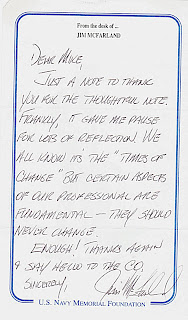
Certain Aspects of Our Profession Are Fundamental - They Should Never Change


Rear Admiral James S. McFarland and I carried on a regular correspondence for almost 20 years. He was a great mentor and a conscientious note/letter writer. This last response was just before his death in February 2003. We had been exchanging ideas about the future of cryptology in our Naval profession. He was committed to the idea that some aspects of our profession were fundamental and should never change.

He was deeply proud of the 10,000 or so Sailors that comprised the Cryptologic Community. He, more than most, understood the value of those Sailors to the Navy and its mission. He believed in taking care of his Sailors and his Sailors knew it.
 Rest in peace Admiral.  Rest in peace.

Thursday, February 2, 2012

Our Community's Foundational Principles

Lots of good stuff HERE.  Some thoughtful, enthusiastic, well-meaning IWs, CTs and other members of the Cryptologic Community put this together.  And, it is endorsed by our community's Flag officers and senior civilian leadership.  Give it a read.  Send some feedback to Commander Sean Heritage, if you have time.  These principles were meant to be shared.  Spread the word.

Morals and Ethics

There  is  abundant   evidence around  us for one to conclude that morals and ethics are becoming less prevalent in people's lives. The standards of conduct  which lay deeply buried in accepted thought  for centuries are no longer absolute. People seem unable to  differentiate  between physical relief and moral satisfaction. Many confuse material success in life with virtue.

Admiral H. Rickover

Wednesday, February 1, 2012

Excellence in Action

Commander Matt Bonner, Commanding Officer of USS CONSTITUTION in Charlestown, Massachusetts is an awesome example of the model commanding officer described in Navigating A New Course to Command Excellence.

Superior commanding officers focus on the big picture. They set priorities, establish policy, and develop long-range plans. They target only a few key issues at a time. In explaining his priorities, one CO says: "I regularly have captain's call with all paygrades so I can reinforce any points that I want to emphasize. I always talk about combat readiness, safety, and cleanliness. And whenever I ask them what my priorities are, they always tell me, "Readiness, safety, and cleanliness." Once they identify the critical needs of the command and chart a direction, these COs accomplish the command's mission by inspiring others and working through them.

This means that superior COs recognize the importance of their relationships with other people, and they concentrate on developing those relationships within and outside the command.  In dealing with the executive officer, superior COs are concerned not only with immediate issues but with overall progress: they look upon the XO as an assistant, but they know that this assistant is a future CO. Together, they discuss plans and review courses of action, and the CO is especially careful to keep the XO informed of command decisions. Whenever possible, the CO delegates, leaving room for the XO to function independently.

In the same way, the best COs develop their department heads and division officers, delegating work and meeting frequently for planning and review. They monitor morale and try to create a climate of mutual support.

They take an interest in the well-being of their officers and express a willingness to talk about significant personal problems. They pay special attention to first-year officers, making sure they start out on a strong career footing.

With more experienced officers, they provide opportunities for professional development and encouragement to move up through the chain of command.