Thursday, January 27, 2022

Born this day in 1900 - Father of the nuclear Navy


27 January 1900 – Hyman Rickover, American admiral the “Father of the Nuclear Navy” was born in Makow, Russia (now Poland). He emigrated to the United States with his family in 1906. He served on active duty with the United States Navy for more than 63 years, receiving exemptions from the mandatory retirement age due to his critical service in the building of the United States Navy’s nuclear surface and submarine force.

He died at home in Arlington, Virginia, on July 8, 1986 and was buried in Section 5 at Arlington National Cemetery. His first wife, Ruth Masters Rickover (1903-1972) is buried with him and the name of his second wife, Eleanore A. Bednowicz Rickover, whom he met while she was serving as a Commander in the Navy Nurse Corps, is inscribed on his gravestone.

Sunday, January 23, 2022

Correspondence is history kept alive


While in command of U.S. Naval Security Group Activity Yokosuka Japan, my Executive Officer (LT Bob Duncan) and I would meet at the command at 0630 or so each morning to spend 30-45 minutes hand writing letters to a different set of parents or relatives of our Sailors to let them know what 'their' Sailor was up to. One in 20 or so letters generated a response from a grateful parent or relative. The letter above is one such letter. The XO and I cared deeply about each of the 200 or so Sailors under our charge. Some of them understood and some didn't. Some came to that understanding later as they transferred to 'less caring' commands. Some still don't understand.

One of the most heart warming examples of the meaning of all this correspondence came on two separate occasions for my Command Master Chief - CTMCM(SW) Ronald N. Schwartz. In 2003 when he retired, his Mother and Father (Ron and Sandra) brought a notebook to his retirement ceremony (over which I presided) at Corry Station, Pensacola Florida (where he started his cryptologic career as a student). The notebook was filled with the letters I sent them regarding the Master Chief's many accomplishments helping me lead our Sailors. There were many letters and news articles sent as he accomplished a great deal. I was gratified to see his parents had kept every letter. In 2007, I saw those same letters in the same notebook in plastic liners at a far less joyous occasion when the Master Chief passed away tragically in an accident. Those letters meant so much to his parents because they reflected a detailed accounting of his very successful career history. His parents and I still exchange letters as I keep them informed of our efforts to keep his name and memory alive in the Navy.

Friday, January 21, 2022

Someone worth following


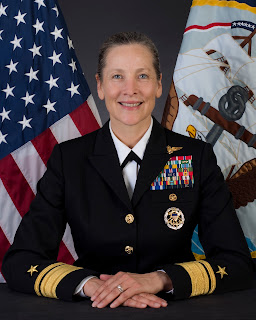
Rear Admiral Shoshana Chatfield is a native of Garden Grove, California, and a 1987 graduate of Boston University with a Bachelor of Arts in International Relations and French Language and Literature. She received her commission through Naval Reserve Officer Training Corps (NROTC) in 1988 and earned her wings of gold in 1989. Chatfield was awarded the Navy's Political/Military (Pol-Mil) Scholarship and attended the Kennedy School of Government, receiving a Master of Public Administration from Harvard University in 1997. 

In 2009, the University of San Diego conferred upon her a doctorate of education. She was assigned to Helicopter Combat Support Squadrons (HC), serving in HC-1, HC-3, HC-5 and twice in HC-11 before making the move to the Helicopter Sea Combat (HSC) community. Operationally, she flew the SH-3, CH-46D and MH-60S and deployed in helicopter detachments to the Western Pacific and Arabian Gulf supporting carrier strike group and amphibious ready group operations. 

Ashore, she participated in the Joint Staff/OSD Internship Program, augmenting the Joint Staff, Plans and Policy (J-5) Directorate, Central; Eastern European Branch; was assigned as deputy executive assistant to the chief of naval operations; was senior military assistant to the supreme allied commander Europe; and was the United States deputy military representative to the NATO Military Committee. 

She served as assistant professor of political science at the United States Air Force Academy from 2001-2004. 

Chatfield was the 20th commanding officer of HC-5 and, upon its disestablishment, the first commanding officer of HSC-25, the Island Knights. 

She subsequently commanded a joint provincial reconstruction team in Farah Province, Afghanistan, in 2008 and was type wing commander of HSC Wing, U.S. Pacific Fleet from 2011-2013. 

Most recently, Chatfield commanded Joint Region Marianas from January 2017 to August 2019. 

 Her personal awards include the Defense Superior Service Medal, Bronze Star Medal, Legion of Merit (two awards), Meritorious Service Medal, Joint Service Commendation Medal, Navy Commendation Medal (three awards), Army Commendation Medal, Air Force Commendation Medal, Joint Service Achievement Medal, Navy Achievement Medal and various unit awards.

Wednesday, January 19, 2022

My dear Admiral...


In the 1940's, the Navy used a form letter to reduce the Flag Officer Ranks. It let "My dear Admiral" down with a gentler bump. Sent in November 1945 to all of the 369 flag officers still on active duty, the Navy's letter simply asked that if (for guidance in future planning) , the admiral wanted to retire— please reply.

Of those who had replied by December 10, 1945, only 16 said they wanted to get out. Among them were Fleet Admiral William F. Halsey; 62-year-old Admiral Royal E. Ingersoll, commander of the Atlantic Fleet throughout most of the war; hardboiled Admiral Emory S. Land, for seven years head of the Maritime Commission. The Navy sent nearly 150 Admirals home who did not request retirement.

Nevertheless, the Navy's stars were rapidly thinned out. Scheduled to go by the end of 1945 were 51 admirals who were recalled to duty after they had already been retired. The Navy hopes by June 1946 to reduce its flag roster from the peak of 400 to 228.

From TIME MAGAZINE, 17 December 1945

Tuesday, January 18, 2022

I am a United States Sailor


I will support and defend the Constitution of the United States of America and I will obey the orders of those appointed over me.

I represent the fighting spirit of the Navy and those who have gone before me to defend freedom and democracy around the world.

I proudly serve my country’s Navy Combat Team with HONOR, COURAGE and COMMITMENT.

I am committed to excellence and fair treatment of all.

Monday, January 17, 2022

It's not rocket science - You're in the people development business


"If you’re a leader, your whole reason for living is to help human beings develop—to really develop people and make work a place that’s energetic and exciting and a growth opportunity, whether you’re running a Housekeeping Department or Google. I mean, this is not rocket science."
"It’s not even a shadow of rocket science. You’re in the people-development business. If you take a leadership job, you do people. Period. It’s what you do. It’s what you’re paid to do. People, period."
Tom Peters

Sunday, January 16, 2022

We lost an amazing Shipmate - CTICS Shannon Mary Kent. We have a duty to remember her.


Who was Shannon Mary (Smith) Kent and why should you care? There are billions of incredible people in this world. They are waiting patiently to have their stories told.You may even be one of them.In this big big world, we can’t know them all but it would be good to know a few. In that incredibly crowded space, I’d like for you to know about Shannon Mary Kent.

If you don’t know her already, it’s too late. She’s gone. But, it’s not too late to know about her. So, I’d like to help tell part of the story of this amazingly brave, sweet girl. She NEVER cowered – ever. I’d like for you to know enough about this brave, sweet girl to care about her, to care about her family (a husband (Joe) and two sons (Josh and Colt); sister (Mariah); Mom (Mary) and Dad (Steven) she left behind and perhaps to care enough about her legacy and memory to write a personal letter to the Secretary of the Navy asking him to name a Navy destroyer after her – USS SHANNON MARY KENT.  (How was that for a run-on sentence?)

She never once worried about recognition, but she is certainly worthy of it. 16 January 2019 marked the end of her young, vibrant, meaningful, and significant 35 years of life. She spent nearly half of her life in the Navy.  She spent her professional career in the top secret world of the Navy Information Warfare Corps.  She was practically unknown to the rest of the world. That is, until she was murdered by a terrorist who detonated an improvised explosive device in Manbij, Syria. 16 January 2019 marks the day that her existence and murder were made known to the entire world.

As a 19 year old, she joined the Navy in 2003 and attended foreign language school at the Defense Language Institute in Monterey, California.  In seven short years she was able to distinguish herself as the top linguist in the Department of Defense while serving with the Naval Special Warfare Support Activity TWO in Virginia Beach, Virginia. She spoke Afghan-Dari, Arabic-Algerian, Arabic-Egyptian, Arabic-Gulf (Iraqi), Arabic-Levantine, Arabic-Standard, French, Portuguese-European, and Spanish.

 Prior to her assignment in Syria, Shannon had previously deployed four times for combat operations on Navy Special Forces actions in Iraq and Afghanistan. She deployed twice with SEAL Team 10 and twice with SEAL Team 4. Syria was her fifth combat deployment in 15 years – and her ninth deployment overall. Where do we find such brave women?  They come from all over America. SMK answered her Navy’s call to action nine separate times.

She spent much of her career in harm’s way.  According to the Center for Military Readiness - “Since the attack on America on September 11, 2001, a total of 149 women deployed to Afghanistan, Iraq, Kuwait, and Syria have lost their lives in service to America.  Most Americans, and even members of the media, are not aware that 149 brave servicewomen have died in the War on Terrorism. With few exceptions, news stories about their tragic deaths usually appeared only in the military press, or in small hometown newspaper stories and television accounts that rarely capture national attention.” Six of those 149 women were serving in the Navy.  Only one of those women took the fight to ISIS in Syria as part of Operation Inherent Resolve – Shannon Mary Kent.

She is the only enlisted woman ever to be honored with a memorial service in the USNA chapel. During that service she was awarded the Bronze Star, the Purple Heart, the Defense Meritorious Service Medal, the Meritorious Service Medal, and a Combat Action Ribbon. About a month later, on 28 February 2019, General Nakasone, Director of the National Security Agency presided over a ceremony to add Senior Chief Petty Officer Shannon Kent’s name to the NSA/CSS Cryptologic Memorial Wall in a solemn ceremony.

Her Cryptologic Warfare Activity SIXTY SIX Shipmates say that CTICS (IW/EXW) Shannon Mary Kent exemplified the Navy’s core values of HONOR, COURAGE and COMMITMENT every moment of every day of her life. Her murder stunned her teammates. Many still have not recovered from the agony of her passing.  She meant so much too so many.

Don’t allow the memory of Shannon Mary Kent’s extraordinarily significant life to disappear as we live our lives. She deserves to be remembered. Shannon’s death is a reminder that, as Katherine Center says, “We are writing the story of our only life every single minute of every day.”

Shannon Mary Kent’s story ended much too early. She wasn’t ready to stop writing her story.  We owe it to her to keep writing it for her. So I ask you to please sit down and write a letter. She fought for you, won’t you join the fight for her?

Won’t you help keep the story of Shannon Mary Kent alive? Please send your letter to: 


Secretary of the Navy 
1000 Navy Pentagon, Room 4D652 
Washington, DC 20350

Short bio:

Captain Reiner W. “Mike” Lambert is a retired naval officer.  He started his career as a Cryptologic Technician Interpretive Seaman (CTISN - Russian linguist) and attended the Defense Language School in 1975-1976.  He was commissioned in 1982, commanded U.S. Naval Security Group Activity Yokosuka, Japan, and served as Secretary of Defense Rumsfeld’s Staff Director for the Detainee Task Force examining detainee abuse in Iraq, Afghanistan, and Guantanamo Bay Cuba.  He retired in 2006 following that assignment.  Today he runs The FARM at DEER HOLLOW with his wife Lynn.  He is also a Principal with Top Corner Consulting.

Saturday, January 15, 2022

Making a difference for Sailors as their leader


1. SAILORS LIKE TO FEEL SPECIAL... COMPLIMENT THEM
The highest compliment a Sailor can receive is one given by his or her Commanding Officer or their Chief Petty Officer. Take the time to notice your Sailor's work and don't hesitate to tell them when they've done a good job. Make a habit of being sincere with your compliments. They know whether you are being genuine or not.
2. SAILORS LOOK FOR A BETTER TOMORROW... GIVE THEM INFORMATION.
When your Sailors are having trouble seeing the light at the end of the tunnel (deployment), remind them of the purpose of their work and help them envision what their work will accomplish. With that information, your Sailors will work harder and longer to see the task through to completion.
3. SAILORS NEED TO BE UNDERSTOOD... LISTEN TO THEM.
Every leader would be wise to heed the Cherokee saying: "Listen to the whispers and you won't have to hear the screams." Don't judge what your Sailors want to tell you before they've told you. Take time to understand your Sailors' points of view and listen to their suggestions. It's the best way to ensure that your Sailors have been listening to you and it opens the door to their innovative ideas for improvement.
4. SOME SAILORS MAY LACK DIRECTION... HELP THEM NAVIGATE.
Part of your job as a leader is to help your Sailors figure out what they're most passionate about, then help them pursue it. Sometimes that may involve a job change within your command or even allowing a Sailor to pursue another opportunity somewhere else. But when you understand that effectiveness comes as a result of surrounding yourself with Sailors who love the mission, it's not difficult to let a Sailor go who doesn't enjoy their work. Spend your best time developing and giving direction to those Sailors who are passionate about the work your command is accomplishing.

Friday, January 14, 2022

The U.S. Navy - An Object of Special Pride


"From our earliest national beginnings the Navy has always been, and deserved to be, an object of special pride to the American people. ... It is well for us to have in mind that under a program of lessening naval armaments there is a greater reason for maintaining the highest efficiency, fitness and morale in this branch of the national defensive service. I know how earnest the Navy personnel are (in their devotion) to this idea and want you to be assured of my hearty concurrence."

President Warren G. Harding, 1922

Thursday, January 13, 2022

A Naval officer


A Naval officer should have a firm handle on not just one or two, but every aspect of his humanity, working to strengthen himself in every way possible. If he is blessed with the gift of intelligence, his academic pursuits should not be chased to the expense of his physical health. Similarly, a creative personality should not lead an officer to isolate himself professionally and ignore the social aspect of his being a Naval officer. Excellence in one of these areas does not take attention away from the pursuit of the others but rather serves only to increase competence in complimentary areas, giving the Naval officer a greater understanding of himself, the Navy and the world around him.

Adapted from "The Art of Manliness"

Wednesday, January 12, 2022

A couple of things about caring for Sailors that I learned at my first command - 1977-1979

Learning is a lifelong process.   "Stop learning - stop living" someone wise once told me.  First commands offer an incredible and long-lasting learning experience if you really pay attention.  I like to think that I did pay attention.

Some of the leadership best practices I picked up from then Captain James S. McFarland (a career-long mentor and later-in-life friend):

- When Sailors reported to the command, he wrote letters to the parents letting them know that their son/daughter had arrived safely in a very distant Misawa, Japan and that his officers and Chiefs would take care of them.  Commands which make this time are remembered long after the Sailor departs.  Some commands have the Department Head or Executive Officer do this.

- Most Sailors were sent to the Naval Air Facility (NAF) Misawa photo lab for their "official Navy photo".  Little did the Sailors know that the CO actually sent these photos back to the parents.  Captain McFarland also sent a copy of my Sailor of the Quarter (SOQ) photo to my parents, as well - along with a copy of "The Misawan" newspaper's SOQ announcement.  Sent in 1979, my family still has these.  

Getting a photo of their Sailor means a lot to parents.  If you doubt it, ask a parent!

My feedback to my CO in 2003.

 Ensigns, don't try this at your command

This is a summary of my 360 degree feedback to a former commanding officer. Skipper, there's no doubt you're going to be a leader in the community; these things may help you.
  • You are a great speaker. Be careful not to lose the feeling behind the words. Words have meaning; actions have con­sequences. Ensure your actions match your words. Some Sailors actually listen to every word. They can sense any hint of insincerity. 
  • Your command philosophy should be written down and distributed widely in the command. This is a huge reason for the CNO's success in the Navy. We all know where he's going and we talk about it. The command wants to follow you. Tell us where you want to go. 
  • Respect our time. Typically, ten or more people are always awaiting your late arrival at some function (staff meeting, wardroom meetings, dinners, graduations, etc). If people believe that you are willing to consistently waste their time, they will stop feeling guilty about wasting yours. 
  • Be consistent with your administration of military justice. It's easy to punish junior members in the command for trivial violations. Applying the same standards across the board does not always work. In fact, the more senior the individual is, the more accountable they should be held for their action or inaction. Everyone is watching and judging. 
  • When senior officers visit the command, maximize their exposure to the junior Sailors of the command. They will benefit the most. 
  • Take your junior officers, Chiefs, and Sailors to lunch or simply go have lunch with them in their mess. Everyone will learn a lot, especially you. 
  • Invite your key command leaders to your home for a social event so they can see how it's done. Juniors need to see how their seniors do this. It's part of the learning process. 
  • Share information with your department heads. It is astounding how much information a commanding officer is exposed to and that is not shared with the department heads. Distributed information is enormously powerful. Your department heads can keep a secret if there is a requirement for secrecy. Trust them. 
  • Don't play favorites with members of the wardroom. It hurts the wardroom and it hurts you. 
  • Focus your calendar on the command 's mission. Ceremonial events and public relations are important, but your time should be spent on those areas the commanding officer can directly influence for the greatest benefit to the command's mission. 
From my January 2007 PROCEEDINGS magazine article "360-Degree Feedback: Can We Handle the Truth?"  You can subscribe to PROCEEDINGS (the professional journal of the U.S. Navy) HERE.


Stay tuned to this blog for the 360-degree feedback I received from everyone following my command tour. It's a very interesting and eye opening experience.

Tuesday, January 11, 2022

Writing


Other things being equal, a superior rating will invariably be given to the officer who has persevered in his studies of the art of self-expression, while his colleague, who attaches little importance to what may be achieved through working with the language, will be marked for mediocrity.

A moment's reflection will show why this has to be the case and why mastery of the written and spoken word is indispensable to successful officership.

As the British statesman, Disraeli, put it, "Men govern with words." Within the military establishment, command is exercised through what is said which commands attention and understanding and through what is written which directs, explains, interprets or informs.

Battles are won through the ability of men to express concrete ideas in clear and unmistakable language. All administration is carried forward along the chain of command by the power of men to make their thoughts articulate and available to others.

There is no way under the sun that this basic condition can be altered. Once the point is granted, any officer should be ready to accept its corollary - that superior qualification in the use of the language, both as to the written and the spoken word, is more essential to military leadership than knowledge of the whole technique of weapons handling.

It then becomes strictly a matter of personal decision whether he will seek to advance himself along the line of main chance or will take refuge in the excuse offered by the great majority: "I'm just a simple fighting file with no gift for writing or speaking."

From: The Armed Forces Officer, 1950