Saturday, November 30, 2013

What can be more important ?


"Mike,

Thanks for your continuing engagement on the vital issue of leadership -- at the end of the day, what can be more important to our Navy and our nation?"

Admiral James Stavridis

Friday, November 29, 2013

Trust

"Men will not trust leaders who feel themselves beyond accountability for what they do."

Admiral Kinnaird R. McKee
Director, Navy Nuclear Propulsion (1982-1989)

Tuesday, November 26, 2013

OPNAV AO - you think you're busy now, just wait!!!

The Vice Chief of Naval Operations Adm. Mark Ferguson said last week the Navy will continue to reduce its number of staff positions. After 10 years of war, the office of the chief of naval operations grew to 2,300 people. With the war ending, Ferguson said Nov. 19 during an Association of the United States Navy luncheon in Arlington, VA, the OPNAV staff will be reduced to 1,500 personnel. The service also reduced 35 flag officer positions and will announce seven more reductions in January, he added.

Monday, November 25, 2013

Writing

Writing is a skill that is improved through practice, so officers should seek every opportunity to write and therefore to improve their technical ability to write. Imagination and the desire for self-improvement play a large part in the effectiveness of an individual's writing.
Some people know the mechanics of how to write, but they are not very good writers because they don't have the imagination to add the appropriate descriptive phrase, adverb, adjective, whatever it is that makes this thing live A little, makes it more readable, more appealing. I don't think you necessarily can teach just anyone to be a professional writer, but you can help them improve, I would encourage young officers not to draw away from the normal approach to writing tasks but to accept them as a challenge to create, just as any other artist does.

Rarely is rewriting unnecessary. Write it, read it, and, as a consequence of reading it, write it again and work it and rework it and get suggestions and get it critiqued.

General Barrow, NAVAL LEADERSHIP - VOICES OF EXPERIENCE

Sunday, November 24, 2013

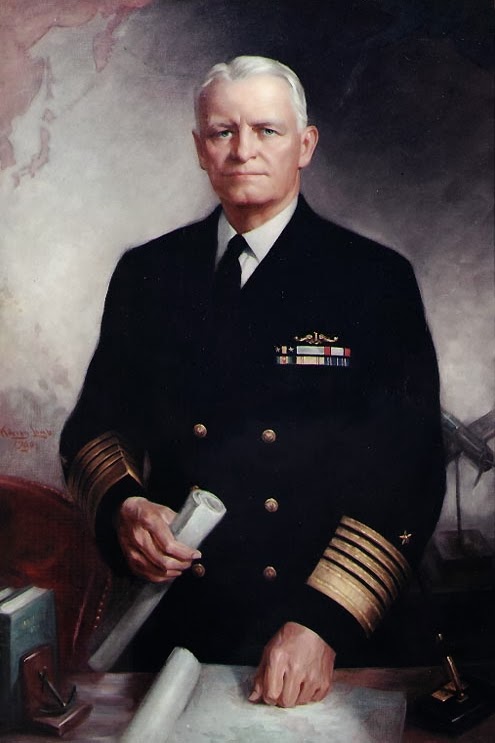
Command Excellence - Admiral Chester Nimitz

Fleet Admiral (FADM) Chester Nimitz created command excellence in every command he was a part of. He did not broadcast his expectations, but conveyed them subtly to his officers. He demanded excellence not for his sake, but for the sake of the men themselves and their own pride and self-fulfillment. Nimitz believed that sound strategy is based on knowledge, information and technical experience. He gave an order and relied on his men to do what they thought best under a given situation. He once said "horses pull harder when the reins lie loose." Nimitz kept his door open to his men. He believed the best ideas did not come from the top, but often from the men. 

From: AN ASSESSMENT OF STRATEGIC NAVAL LEADER COMPETENCIES
Commander Michael A. Strano

"I'm still learning every day. I still try to do my best and refuse to worry about things over which I have no control." 
- Fleet Admiral Chester Nimitz

Saturday, November 23, 2013

Example of virtue, honor, patriotism and subordination

All commanding officers and others in authority in the naval service are required to show in themselves a good example of virtue, honor, patriotism, and subordination; to be vigilant in inspecting the conduct of all persons who are placed under their command; to guard against and suppress all dissolute and immoral practices, and to correct according to the laws and regulations of the Navy, all persons who are guilty of them; and to take all necessary and proper measures, under the laws, regulations, and customs of the naval service, to promote and safe guard the morale, the physical well-being, and the general welfare of the officers and enlisted persons under their command or charge.

U.S. Navy Regulations, Article 702A (original)

The CHARGE OF COMMAND Reminder HERE.  Ignored by many.

Friday, November 22, 2013

CNO on Electronic Warfare

So establishing a better awareness (of the electronic environment), is number one. 

Two, we have got to be more agile, and I kind of mentioned that. We’ve got to be agile in our systems, but we’ve got to be agile in our own operations, in our ability to move around this and understand it. That gets to, that’s strike packages, that’s using our radars, that’s building the radars that can use different frequencies and get out of frequencies when we should and invest in them right off the bat. 

It’s really putting cyber teams together that can be more agile. (VADM) Mike Rogers has done a fantastic job up at 10th Fleet/Fleet CyberCom, doing that. In fact he is leading the way in the overall CyberCom arena in that regard. And we’ve got to evolve this paradigm that I just kind of mentioned to you, how we are going to approach things in the future. If they say hey, so and so just developed a new missile. A lot of times the question is can we shoot it down? The real question I think should be can we jam it, spoof it, avoid it? Can we detect it? And then similarly, whenever we’re designing a new missile, a lot of people want to say bigger warhead, bigger boost. I would say what’s the [seeker] like? What can it do in a turn? How can it avoid things? It’s an entire change to that kill chain approach. 

You can read his extemporaneous talk with the Association of Old Crows HERE.

Submariners are not typically the Navy's experts in EW so give the CNO some latitude here.

Thursday, November 21, 2013

Overheard in the passageway


"Humility doesn't get any respect in this wardroom."

And my response to that is a quote from Tony Schwartz at Life@Work.

"Humility is a way of acknowledging that none of us stand at the center of the universe. No matter what role we occupy, or how much we know, we don’t have a lock on the answers. A position of authority over others scarcely guarantees that you have real authority.
When leaders openly accept the whole of who they are – for better and for worse – they no longer have to defend their value so vigilantly."
Are you being too defensive?

Wednesday, November 20, 2013

In the battle of ideas


One of my Shipmates shared this philosophy that his boss has on his desk.

Small Idea = Small Problem
Big Idea = Big Problem
No Idea = No Problem

I think the gist of it is that he wasn't interested in anyone's ideas. 

Tuesday, November 19, 2013

We've all been assigned to that great command and marveled at how much fun it was to be a part of its success.

And then you hear from your Shipmates who are there now, that the once great command is no more. How does that happen?  It's actually easy to understand.  Sailors make a command great and it is a rare time indeed when you get just the right Sailors in the right command at the right time with the right leadership.  With Sailors transferring in and out on a continuous stream of PCS orders, it doesn't necessarily have to be this way.  The great command can remain great and the suffering commands can get better.

Patrick Lencioni suggests that commands not wait for "right Sailors, right leaders, right time" moment but rather build an organizational health which can sustain excellence over a long period of time.  To paraphrase him for the Navy model:


Organizational health is about making a command function effectively by building a cohesive leadership team, establishing real clarity among those Navy leaders, communicating that clarity to all the Sailors, Chiefs, civilians and contractors within the command and putting in place just enough structure to reinforce that clarity going forward.
The advantage of organizational health is undeniable and massive. Commands get more done in less time. They avoid losing their best Sailors, Chiefs, civilians and contractors. They identify problems earlier and solve them faster. They fill the gap for low performing commands which waste time, money and energy fighting among themselves, which ultimately drives away good Sailors, Chiefs, civilians and contractors.


You can read more about his ideas HERE.

Monday, November 18, 2013

Top 50 Thinker - Top 10 Leadership Thinker


How does one become a peer recognized leadership thinker?  It doesn't happen by accident, I can promise you that.  Several years ago I read Liz Wiseman's book MULTIPLIERS - How The Best Leaders Make Everyone Smarter and thought to myself "Liz Wiseman belongs on the Thinkers50 list."  Then, I told Liz that I thought she belonged on the list.  Together with Liz, we provided her excellent book to people in the IDC we thought were leading thinkers and doers - Commanding Officers.  A few of them actually read the book and took some of the lessons to heart and practiced them.  Some are still hard at it today but, only a few.

Quite honestly, most did not bother with the book or try to learn anything new.  Many in senior Navy leadership positions believe that, because the Navy has placed them in leadership positions, they have arrived and have nothing more to learn.  Admiral Vern Clark put it into my head in 2000 that I would have to devote myself to lifelong learning and so I have.  I make a point to learn every day.  And, I try to improve my learning by doing a little teaching as well.

Liz has taught around the world, including the Senior Leadership Seminar at the Naval Postgraduate School in Monterey, California. Teaching others is how Liz Wiseman became a Thinkers50 - Top 10 Leadership Thinker.  She shares her considerable experience and knowledge with others at every opportunity.  And, in that sharing, she has become known around the world for helping everyone around her become smarter.  She has truly brought out the genius in so many people.  Congratulations Liz!


Sunday, November 17, 2013

2014 CALL FOR NOMINATIONS FOR THE CAPTAIN JOSEPH ROCHEFORT INFORMATION WARFARE OFFICER DISTINGUISHED LEADERSHIP AWARD

CAPTAIN JOSEPH ROCHEFORT
REPOSTED FROM "ON THE NET GANG"

It is time for us Information Warfare Officers to nominate our deserving peers, CWO2 to O5, for recognition of their "superior career achievement".

Nominations are due to FCCC10FNSAHAWARDS@NAVY.MIL NLT 07 February 2014.

There were 7 nominations for the 2013 award.  The 2013 winner was LCDR Lemuel "Seth" Lawrence, executive officer of Navy Information Operations Command Pensacola.

SUBJ/2014 CALL FOR NOMINATIONS FOR THE CAPTAIN JOSEPH ROCHEFORT INFORMATION WARFARE OFFICER DISTINGUISHED LEADERSHIP AWARD
MSGID/GENADMIN/COMTENTHFLT//
POC/JERRY BECKLEHIMER/CIV/COMUSFLTCYBERCOM FORT MEADE MD/TEL: 443-634-4676//
GENTEXT/REMARKS/PASS TO FLEET INFORMATION WARFARE AND CRYPTOLOGIC UNITS/SSES
1. THE PURPOSE OF THIS MESSAGE IS TO SOLICIT NOMINATIONS FOR THE CAPTAIN JOSEPH ROCHEFORT INFORMATION WARFARE (IW) OFFICER DISTINGUISHED LEADERSHIP AWARD.
2. CAPTAIN JOSEPH JOHN ROCHEFORT WAS A MAJOR FIGURE IN THE U.S. NAVYS CRYPTOLOGIC AND INTELLIGENCE DEVELOPMENT FROM 1925 TO 1947. HE HEADED THE NAVYS FLEDGLING CRYPTANALYTIC ORGANIZATION IN THE 1920 S AND PROVIDED SINGULARLY SUPERB CRYPTOLOGIC SUPPORT TO THE FLEET DURING WORLD WAR II, LEADING TO VICTORY IN THE WAR IN THE PACIFIC. AT THE END OF
HIS CAREER (1942-1946), ROCHEFORT SUCCESSFULLY HEADED THE PACIFIC STRATEGIC INTELLIGENCE GROUP IN WASHINGTON. ROCHEFORT DIED IN 1976. IN 1986, HE POSTHUMOUSLY RECEIVED THE PRESIDENTS NATIONAL DEFENSE SERVICE MEDAL, THE HIGHEST MILITARY AWARD DURING PEACETIME, FOR HIS CONTRIBUTIONS DURING THE BATTLE OF MIDWAY.
3. THE INTENT OF THE CAPTAIN ROCHEFORT IW OFFICER DISTINGUISHED LEADERSHIP AWARD IS TO ANNUALLY RECOGNIZE THE SUPERIOR CAREER ACHIEVEMENT OF ONE IW OFFICER. IN THE SPIRIT OF CAPTAIN ROCHEFORT, SPECIFIC CONSIDERATION WILL BE GIVEN TO LEADERSHIP, TEAMWORK, OPERATIONAL CONTRIBUTIONS AND ADHERENCE TO THE PRINCIPLE BY WHICH HE SERVED, WE CAN ACCOMPLISH ANYTHING PROVIDED NO ONE CARES WHO GETS THE CREDIT."
4. IW OFFICERS (181X, 644X AND 744X) RANGING FROM CWO2 TO COMMANDER ARE ELIGIBLE FOR THE AWARD WITH CONSIDERATION GIVEN TO CONTRIBUTIONS WHILE SERVING AS BOTH IW OFFICERS AND CRYPTOLOGIC TECHNICIANS.
5. NOMINATION PROCEDURES:
A. PEER NOMINATIONS WILL BE THE ONLY SOURCE OF NOMINATIONS.  ONLY COMMISSIONED OFFICERS WHO ARE THEMSELVES ELIGIBLE TO BE SELECTED IN THE SELECTION YEAR MAY NOMINATE ONE PEER. THE NOMINATION WILL BE MADE ON A TWO PAGE, SIGNED LETTER CONTAINING THE FULL NAME AND UNIT OF THE PEER NOMINATED WITH TYPED JUSTIFICATION (WHICH WILL BE HELD IN CONFIDENCE) BASED ON THE CRITERIA. THE NOMINATION LETTER WILL BE FORWARDED DIRECTLY TO COMFLTCYBERCOM AWARDS VIA EMAIL AT: FCCC10FNSAHAWARDS(AT)NAVY.MIL NLT 7 FEB 2014.
B. NOMINATIONS WILL BE REVIEWED BY A SELECTION BOARD OF CAPTAINS DESIGNATED BY COMFLTCYBERCOM. FINAL SELECTION WILL BE MADE BY THE COMMANDER.
6. AWARD SELECTION WILL BE ANNOUNCED VIA NAVAL MESSAGE. PRESENTATION VENUE OF THE AWARD WILL BE ACCOMPLISHED AT THE U.S. NAVAL CRYPTOLOGIC VETERANS ASSOCIATION ANNUAL CONVENTION TO BE HELD IN MID MAY 2014 (IF FUNDING IS AVAILABLE BY THE COMMAND ATTACHED.) THE AWARDEE WILL RECEIVE A PLAQUE COMMEMORATING SELECTION AND A DISPLAY IN THE FLTCYBERCOM HERITAGE ROOM WILL HONOR ALL AWARDEES.//

Friday, November 15, 2013

Two Legitimate Questions

Two legitimate questions to ask in any command are: "What does the Chiefs' Mess assure in this ship? And, what do they provide that requires little or no officer involvement?"
 
The captain should be able to ask the Chiefs' Mess to take care of something important, and in an idealized world, that would be the end of it. Actually, the captain shouldn't even have to ask.
 
The chiefs would know what needed to be done, without signal, simply through their collective breadth of knowledge and experience. This is not what happens.
 
The sum is no longer greater than its parts, and that collective engine of expertise and experience is faltering. Indeed, to guarantee success it has become necessary to find some new engine to bind and drive forward motion. Short of that synergistic Chiefs' Mess, the disconnected nodes and fragments and individuals of a ship are now, we hope, driven in the right direction by a few individuals who vary ship to ship or unit to unit.
 
Certainly, some of these driving individuals may be chiefs, but the idea of the Mess being the engine that organizes and informs all activity is not generally the case.
 
From
Reviving the Chiefs' Mess HERE
Captain Kevin S. Eyer
He commanded the USS Thomas S. Gates (CG-51), USS Shiloh (CG-67), and USS Chancellorsville (CG-62). 
 
MY NOTE:
The issue of: "What is the Chiefs' Mess responsible for?" came up during my discussion with one of the senior officers in our community.  He said, "Your thoughts on this are really appreciated.  We have it pretty easy at our command. We just do things the Navy way."  Then, he pointed me to the NAVY NEWS article about some excellent training required for CPO, SCPO and MCPO.  
 
IS YOUR COMMAND MASTER CHIEF RUNNING THIS TRAINING FOR YOUR CPO MESS?  
Or is this just more training that you don't have time to do?
 
Some excerpts are below:
 

New Chief's Mess Training Course Released


Story Number: NNS130528-09Release Date: 5/28/2013 1:23:00 PM
By Susan Henson, Center for Personal and Professional Development Public Affairs
 
VIRGINIA BEACH, Va. (NNS) -- The Center for Personal and Professional Development (CPPD) has released the revised Chief's Mess Training (CMT) course, CPPD leadership said May 28.

The CMT course is year-round training with lessons that provide additional leadership topics for the Chief Petty Officer (CPO) mess. The course took six months to revise and was piloted in the Hampton Roads area in December.

CMT provides CPOs with the tools to lead with courage, respect and trust, as well as the tools to mentor our junior Sailors to become the next generation of strong Navy leaders.

The new CMT is a library of 22 current, relevant topics that include scenarios designed to facilitate deep discussion. Each session can be taught at any time and in any sequence throughout the year, according to Hazley. "The previous CMT consisted of 10 topics designed to be delivered every month from October to July each year," he said. "The new course provides flexibility to CPO messes to cover topics in a sequence that best fits a command's schedule."

CMT is designed to provide leadership sustainment training for chief petty officers through communication, teamwork and mentoring.

(CMT) is intended to enable the mess as a whole to learn from each other's experiences and develop the problem-solving skills chiefs must have to succeed. Topics include command unity, ethics, operational stress control, maintaining standards, mentoring, conflict resolution, character and integrity, professionalism, suicide awareness, bystander intervention, and prevention of sexual assault, sexual harassment and hazing. 

Chief of Naval Operations Instruction (OPNAVINST) 5351.2A governs CMT, which is required for all active duty and reserve chiefs, senior chiefs and master chiefs. The revised CMT course will be documentable in Fleet Training Management and Planning System (FLTMPS).

Commands can access the new course material by logging on to Navy Knowledge Online, selecting the Leadership tab, selecting Chief Petty Officer Selectee Leadership Course (CPOSLC) /CMT and following the instructions on the screen. Commands experiencing problems accessing the material should contact the course manager at CPPD for assistance.


Thursday, November 14, 2013

The supreme quality is missing in a few of our senior officers

The supreme quality for leadership is unquestionably integrity. Without it, no real success is possible.
DWIGHT DAVID EISENHOWER