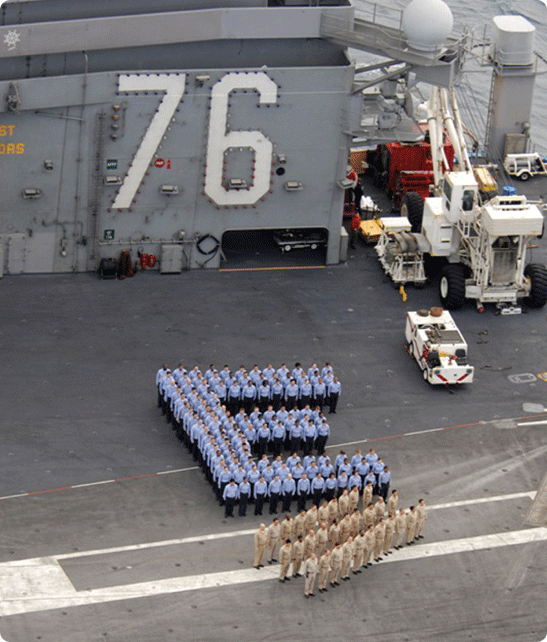
The wardroom in a superior command:
• Is Cohesive
• Matches CO-XO Leadership
• Raises Concerns with CO and XO
• Takes Initiative
• Does Detailed Planning
• Takes Responsibility for Work-Group Performance
The wardroom is the interface between the senior officers of the command, who make the policy, and the senior enlisted, who carry out the tasks of the command. The wardroom is responsible for developing and imple- menting plans that achieve the goals set by the CO and XO. In top commands, the department heads and division officers make sure these plans are specific, deciding who is to do what, when, and how. They gather information from chiefs and other relevant sources, and are careful to coordinate their department's or division's activities with other work going on.
This means that the wardroom must work as a team with the CO and XO. In superior commands there is more congruence between the wardroom and the CO-XO on command philosophy and leadership style than in average commands. Everyone is headed in the same direction. They identify with the goals set by the CO and XO and with how the CO and XO wish to accomplish them.
Officers of superior commands take initiative in several ways. They try to find new and better ways to do their jobs, and when they see that something needs to be done, they do it without waiting to be told. They are often willing to do more than they are required to do in order to achieve the command's mission. And they readily ask for guidance or information from the CO or XO if they believe these are necessary to accomplish their jobs or to develop themselves professionally. They also raise command issues with senior officers before those issues turn into serious problems.
One of the greatest strengths of wardrooms of superior commands is their sense of responsibility for the performance of their subordinates. This leads them to try to anticipate problems before they occur, to take responsi- bility when a problem does occur that they should have prevented, and to hold their personnel accountable for meeting the command's standards. There is a strong sense of ownership and pride.
Finally, superior wardrooms support division officers, who, although they outrank enlisted personnel, are among the youngest people in a command and are relatively inexperienced when it comes to hands-on technical knowledge and management know how. Thus, department heads must do their own jobs and also attend to the needs of their junior officers.
FOR MORE ON COMMAND EXCELLENCE, GO HERE.
Musings, leadership tidbits and quotes posted by a retired Navy Captain (really just a high performing 2nd Class Petty Officer) who hung up his uniform a bit too early. He still wears his Navy service on his sleeve. He needs to get over that. "ADVANCE WARNING - NO ORIGINAL THOUGHT!" A "self-appointed" lead EVANGELIST for the "cryptologic community". Keeping CRYPTOLOGY alive-one day and Sailor at a time. 2015 is 80th Anniversary of the Naval Security Group.
Friday, December 31, 2010
Wednesday, December 29, 2010
Training Sailors
A different slant on a very popular Chinese proverb:
"The best time to train a Sailor was yesterday. The second best time is today. Train your Sailors. You won't regret it."
Tuesday, December 28, 2010
Information Warfare Officer, Commander John Hunter decodes Civil War message
A glass vial stopped with a cork during the Civil War has been opened, revealing a coded message to the desperate Confederate commander in Vicksburg on the day the Mississippi city fell to Union forces 147 years ago.
The dispatch offered no hope to doomed Lt. Gen. John C. Pemberton: Reinforcements are not on the way.
The encrypted, 6-line message was dated July 4, 1863, the date of Pemberton's surrender to Union forces led by Ulysses S. Grant, ending the Siege of Vicksburg in what historians say was a turning point midway into the Civil War.
The message is from a Confederate commander on the west side of the Mississippi River across from Pemberton.
"He's saying, 'I can't help you. I have no troops, I have no supplies, I have no way to get over there,"' Museum of the Confederacy collections manager Catherine M. Wright said of the author of the dispiriting message. "It was just another punctuation mark to just how desperate and dire everything was."
A Navy cryptologist independently confirmed Gaddy's interpretation. Commander John B. Hunter, an information warfare officer, said he deciphered the code over two weeks while on deployment aboard an aircraft carrier in the Pacific. A computer could have unscrambled the words in a fraction of the time.
"To me, it was not that difficult," he said. "I had fun with this and it took me longer than I should have."
From FOX news. The whole story is HERE.
Wednesday, December 22, 2010
Re DADT - Please continue to exhibit honor, integrity and moral courage.
As always, the men and women of our Armed Forces are the Nation’s most important strategic resource. Only a force of dedicated, highly educated and well-trained men and women capable of leveraging new ideas will succeed in the complex and fast-paced environment of future military operations. Moreover, this force must exhibit honor, integrity, competence, physical and moral courage, dedication to ideals, respect for human dignity, the highest standards of personal and institutional conduct, teamwork, and selfless service.
Tuesday, December 21, 2010
Best of her time - A woman cryptologist worthy of our considerable attention
One of the best cryptanalysts of her time, Agnes Meyer Driscoll, worked for the Navy as a civilian and as a Yeoman Chief Petty Officer. Known to some as "Miss Aggie" and "Madame X", she was a math teacher before joining the Navy in 1918. The Navy introduced her to her life's work in cryptology.
Following World War I, except for a few years in the 1920s when she worked for another cryptographic pioneer, Edward Hebern, Agnes continued in cryptology with the Navy and other organizations (including NSA) for the rest of her career. She is credited with making breaks into most of the Japanese naval codes OP-20-G worked on.
In the Navy, she was without peer as a cryptanalyst. Some of her pupils, like Ham Wright, were more able mathematicians but she had taught cryptanalysis to all of them, and none ever questioned her talent and determination in breaking and ciphers.
Among her uniformed naval colleagues, she was held in the highest esteem throughout her long career, which continued from the office of naval communication to the Armed Forces Security Agency, and then to the National Security Agency.
Women accepted into the cryptologic field were sworn to secrecy. The penalty for discussing the work outside of approved channels could be death, as it was considered an act of treason during a time of war.
She was buried at Arlington National Cemetery in 1971.
Following World War I, except for a few years in the 1920s when she worked for another cryptographic pioneer, Edward Hebern, Agnes continued in cryptology with the Navy and other organizations (including NSA) for the rest of her career. She is credited with making breaks into most of the Japanese naval codes OP-20-G worked on.
In the Navy, she was without peer as a cryptanalyst. Some of her pupils, like Ham Wright, were more able mathematicians but she had taught cryptanalysis to all of them, and none ever questioned her talent and determination in breaking and ciphers.
Among her uniformed naval colleagues, she was held in the highest esteem throughout her long career, which continued from the office of naval communication to the Armed Forces Security Agency, and then to the National Security Agency.
Women accepted into the cryptologic field were sworn to secrecy. The penalty for discussing the work outside of approved channels could be death, as it was considered an act of treason during a time of war.
She was buried at Arlington National Cemetery in 1971.
Monday, December 20, 2010
Excellence as the standard
"Admiral Rickover was the genius that gave a generation of naval officers the idea that excellence was the standard."
Sunday, December 19, 2010
Aye, Aye Sir !
“Successful implementation will depend upon strong leadership, a clear message and proactive education throughout the force. With a continued and sustained commitment to core values of leadership, professionalism and respect for all, I am convinced that the U.S. military can successfully accommodate and implement this change (repeal of DADT), as it has others in history.”Secretary of Defense, Robert M. Gates
Saturday, December 18, 2010
176 Hawaii Sailors earn information dominance warfare pin
The U.S. Pacific Command (PACOM) director for intelligence, Rear Admiral Elizabeth Train, presented the first group of 176 Sailors from Navy Region Hawaii with the new information dominance warfare insignia aboard the USS Missouri Memorial in Pearl Harbor on December 15, 2010.
Admiral Train presented the insignia to 176 Sailors, both officer and enlisted, who completed a rigorous personal qualification program in information intensive fields.
The warfare pin identifies professionals who possess extensive skills to develop and deliver dominant information capabilities in support of U.S. Navy, joint and nation warfighting requirements.
Some video from the first pinning at the Naval Observatory is HERE.
Admiral Train presented the insignia to 176 Sailors, both officer and enlisted, who completed a rigorous personal qualification program in information intensive fields.
"The ceremony today is a milestone event. It's a significant restructuring of the Navy today. This is a tremendous time and opportunity for all of us, all of you, to develop the next generation of leaders."
Admiral Liz Train
Some video from the first pinning at the Naval Observatory is HERE.
Friday, December 17, 2010
Have we moved this forward?
The Department of the Navy endorses the secure use of Web 2.0 tools to enhance communication, collaboration, and information exchange; streamline processes; and foster productivity improvements. Use ofthese tools supports Department of Defense (DoD) and DON goals of achieving an interoperable, net-centric environment by improving the warfighter's effectiveness through seamless access to critical information. Web 2.0 tools are useful in a global enterprise, such as the DON,' as they enable widely dispersed commands and personnel to more effectively collaborate and share information. The gains in productivity, efficiency, and innovation can be significant. Commands are encouraged to use Web 2.0 tools, consistent with applicable laws, regulations, and policies.
Thursday, December 16, 2010
A worthy goal - we're still working to get there
Fundamental to the concept of net-centricity lies the precept that shared awareness, collaboration, and self-synchronization can be attained through the networking of knowledgeable, geographically and hierarchically dispersed entities.
We can't assemble the puzzle without your piece. Get your geographically and hierarchically dispersed idea over here. We need it.
Wednesday, December 15, 2010
Information Dominance Corps Leadership Focus - Commander, Naval Network Warfare Command
Rear Admiral Edward H. Deets III
Rear Admiral Deets is a native of Charlottesville, Va. He graduated from Duke University in 1979 where he was commissioned an ensign via the Naval Reserve Officer Training Corps.
Deets began his information warfare officer career at the Naval Security Group Activity Kunia, Hawaii. There he served as a direct support officer aboard a variety of ships in the Western Pacific, Indian Ocean, North Arabian Sea, and the Mediterranean.
His next tour was at the Naval Security Group Activity Pyongtaek, Republic of Korea, as the executive officer. From there, he was assigned to the staff of commander in chief, United States Atlantic Fleet.
In 1991, he reported to commander, Carrier Group 2 aboard USS John F. Kennedy (CV 67) as the staff cryptologist. He deployed to the Mediterranean Sea and also participated in several counternarcotics operations on various ships. In 1993, he became the cryptologic junior officer detailer at the Bureau of Naval Personnel in Washington, D.C. Next, he spent two years on the staff of the U.S. 6th Fleet in Gaeta, Italy, as the command and control warfare officer. He also attended the National War College at Fort McNair, Washington, D.C., where he graduated with honors in 1998. He served a follow-on joint assignment as the executive assistant to the National Security Agency chief of staff.
Deets' personal awards include the Legion of Merit, the Defense Meritorious Service Medal, the Meritorious Service Medal with gold star, the Navy and Marine Corps Commendation Medal with two gold stars, the Army Commendation Medal, and the Navy and Marine Corps Achievement Medal. He holds a Master of Science degree in National Security Strategy with a concentration in Information Strategies.
Tuesday, December 14, 2010
Pick your best six ? - Compressed Zone Opportunity for IW Captain in FY12
Blog post and comments have been deleted at the request of the offended.
Monday, December 13, 2010
Admiral Harvey's Focus on Practices of Successful Commands
On his CFFC Blog, Admiral Harvey posted the third in a series of messages about the "Practices of Successful Commands". His messages provide a great summary of some of those practices. You can go to his blog HERE.
For much greater detail and the full report on Command Excellence, you should really go HERE.
A short excerpt follows regarding the function of training in superior/excellent commands.
Training in superior commands links directly to combat readiness. Training for 'training's sake' is avoided. If a drill or exercise doesn't advance the combat readiness of the command, then it's changed around until it does.
Top commands don't question the value of training. The wardroom is key in coordinating training activities throughout the command. Each department commits itself to bringing its people up to speed. There is a give-and take in working with other departments to coordinate training activities. Training is targeted to get personnel closer to combat readiness. This drives the effort to keep training realistic and practical.
In outstanding commands all levels are involved in training and development. The wardroom coordinates the training, but the involvement of junior enlisted personnel with critical areas of expertise is crucial to training program success. Top wardrooms make their presence felt by continually monitoring programs to keep their commands combat ready.
Finally, superior commands are committed to the professional development and career planning of their people. Junior officers make sure their people are continuing to advance and qualify. Department heads take the lead in making sure division officers become qualified.
For much greater detail and the full report on Command Excellence, you should really go HERE.
A short excerpt follows regarding the function of training in superior/excellent commands.
Training in superior commands links directly to combat readiness. Training for 'training's sake' is avoided. If a drill or exercise doesn't advance the combat readiness of the command, then it's changed around until it does.
Top commands don't question the value of training. The wardroom is key in coordinating training activities throughout the command. Each department commits itself to bringing its people up to speed. There is a give-and take in working with other departments to coordinate training activities. Training is targeted to get personnel closer to combat readiness. This drives the effort to keep training realistic and practical.
In outstanding commands all levels are involved in training and development. The wardroom coordinates the training, but the involvement of junior enlisted personnel with critical areas of expertise is crucial to training program success. Top wardrooms make their presence felt by continually monitoring programs to keep their commands combat ready.
Finally, superior commands are committed to the professional development and career planning of their people. Junior officers make sure their people are continuing to advance and qualify. Department heads take the lead in making sure division officers become qualified.
Sunday, December 12, 2010
Professionalism of our cryptologic force
The professionalism of our force is built upon mastery of a core set of skills that every cryptologic professional must possess. It all starts with a deep understanding of the fundamentals of cryptology, and a requirement that our professionals think clearly, and convey their analysis and assessments just as clearly to our Navy and our nation's decision-makers.
Saturday, December 11, 2010
New Navy CIO's First Blog Post on DONCIO Blog is his last
The CIO's Last Blog
By Terry Halvorsen
Published, December 1, 2010
More HERE. Change is good...
By Terry Halvorsen
Published, December 1, 2010
I'm sure you'll find it interesting and maybe a bit ironic that the new CIO's first blog is his last blog. I believe in the value of social media and believe it has its place in the Department of the Navy. However, as I am focusing on finishing up my duties as Deputy Commander of Navy Cyber Forces and taking the reigns as DON CIO, blogging must be a lower priority. There is much work to be done, and I plan to fully engage with the Navy, Marine Corps and Secretariat level leaders through face-to-face meetings when possible.
More HERE. Change is good...
Subscribe to:
Posts (Atom)