Sunday, October 31, 2010

Cherokee Indian Naval Aviator Number ONE

Admiral Clark was born in Pryor, Oklahoma, on 12 November 1893, son of Cherokee Indian William A. Clark and Lillie Berry Clark. He attended Willie Halsell College, Vinita, Oklahoma, and the Oklahoma Agricultural and Mechanical College, at Stillwater; and graduated from the US Naval Academy with the class of 1918 in June 1917. He was the first Native American graduate of the naval Academy. He was the first Cherokee Indian to be designated a naval aviator.

More on the Admiral HERE.

This is one extraordinary individual.  In 1952 he was commander of U.S. SEVENTH Fleet.  Admiral Clark was an honorary chief by both the Sioux and Cherokee nations. He died 13 July 1971 at the Naval Hospital, St. Albans, New York, and is buried in Arlington National Cemetery. 

In addition to the Navy Cross, the Distinguished Service Medal with Gold Star, the Legion of Merit, the Silver Star Medal, the Commendation Ribbon, and the Presidential Unit Citation Ribbon with two stars, Rear Admiral Clark has the Victory Medal, Escort Clasp (USS North Carolina), and is entitled to the American Defense Service Medal with Bronze "A" (for service in the old USS Yorktown which operated in actual or potential belligerent contact with the Axis Forces in the Atlantic Ocean prior to December 7, 1941); the European-African-Middle Eastern Area Campaign Medal with one bronze star; the Asiatic-Pacific Area Campaign Medal with twelve bronze stars; the Philippine Liberation Ribbon with one bronze star; and the World War II Victory Medal.

November is the Navy's focus month for Native Americans.  Nice to learn more about our heritage.

Saturday, October 30, 2010

Trying to Understand the 'Warfighting Wholeness' concept

Our Naval Warfare Integration Group (N00X) is leading a series of warfighting wholeness assessments to identify potential gaps and align resources to fill those gaps. 
Way Ahead:
  • We will use warfighting wholeness reviews to identify capability gaps and direct our limited resources to areas with greatest impact.
CNO in his guidance for 2011.
"We have established a process - fully integrated with the Marine Corps - that allows us to make more informed decisions regarding the investments we are making.  By aligning our process, the Naval Capability Development Process, under the "pillars" of Sea Power 21: Sea Shield, Sea Strike, Sea Basing and FORCEnet, we are able to programmatically and fiscally transform these concepts into Naval Capabilities. It also allows us to take an approach that develops 'warfighting wholeness' across the full range of appropriation accounts. "
 
"By 'warfighting wholeness' I mean a balanced approach to current readiness and future readiness across the spectrum of warfighting mission capabilities.  Maximizing our aggregate warfighting capability, or creating 'warfighting wholeness,' was our overarching goal as we developed our recommendations for the budget request."
Vice Admiral John Nathman, April 2003, Congressional testimony 

"We view the requirements generation process as a holistic endeavor that looks at capability packages not single systems or platforms. By warfighting wholeness, we mean a product where no one owns any one program, where good enough is good enough and we have an end state in mind."

From: CNO and OPNAV Reorganization
By: RONALD E. RATCLIFF

"Warfighting Wholeness replaces sub-optimal stovepipes".
From the CNO's Vision
"We employ the Naval Capability Development Process (NCDP) and Expeditionary Force Development System (EFDS). The NCDP and EFDS take a concepts-to-capabilities approach to direct investment to achieve future warfighting wholeness. The NCDP takes a sea-based, offensive approach that provides power projection and access with distributed and networked forces featuring unmanned and off-board nodes with penetrating surveillance via pervasive sensing and displaying that rapidly deliver precision effects."

THE HONORABLE JOHN J. YOUNG, JR.
ASSISTANT SECRETARY OF THE NAVY
(RESEARCH, DEVELOPMENT, AND ACQUISITION) in testimony to the Senate Armed Services Committee.


Naval Capability Development Process
The Naval Capability Development Process allows the Navy to  develop “warfighting wholeness” to achieve balance among the pillars of Sea Power 21 in a manner that focuses investment across the full range of appropriation accounts.
This process incorporates strategic guidance from Strategic Planning Guidance, Transformation Planning Guidance, National Security Strategy, and Joint Operating, Functional, and Integrating Concepts. Capability development is derived from various warfighting scenarios that look across the next 15 to 20 years. Force capability metrics – “What it takes for the maritime component of the Joint force to win…” – help determine the best way to identify the capabilities that meet the metrics within available resources.
The analytical insights then focus investment not only in acquisition programs (including research and development) but also in science and technology. The Chief of Naval Research plays an important role in developing transformational capabilities that one day will contribute significantly to achieving warfighting wholeness.
Admiral Cosgriff, Congressional Testimony

And, some more from OPNAVINST 5420.108D  CNO Executive Decision Making Process:

Forum: Warfighting Wholeness Review
Chair: CNO
Membership: VCNO, DNS, N1, N2/N6, N3/N5, N4, N8, N00X, ONR, others as required
Periodicity: As required
Charter: Per N00X Charter and CNO guidance
Description:  Identify capability gaps and seams across doctrine, organization, training, materiel, leadership, personnel and facilities (DOTMLPF) and align resources to fill those gaps. These efforts will be led by N00X with support from the Navy staff, warfare centers of excellence, and the fleet.

Friday, October 29, 2010

Save the date - 11 March 2011


Celebrating Our Community History and Heritage

Leaders, request widest dissemination to our IWO/CT Community, civilian and military, Active, Reserve, and retired.

As you know, we have an extraordinarily rich history and heritage and to recognize that, I want to celebrate our Community anniversary.  On 11 March 1935, the "Communications Security Group" was established.  While Naval Cryptology had been at work for many years, this date marks the birth of our Community, the first use of the term "Group" to describe us as a unified whole.

Next year is our 76th anniversary.  I have asked CAPTs Stephanie Keck and Brian Johnston to co-sponsor a celebration in Hampton Roads.  Save the date:  11 March 2011.

Much more to follow.  All the best and enjoy the weekend, 

Rear Admiral Edward H. Deets III
Commander, Naval Network Warfare Command

Hang them out there


"
But the bottom line is that your ideas will not go anywhere unless you have the courage to “hang them out there” for others to see."

Admiral James Stavridis in his blogpost about writing HERE.

Thursday, October 28, 2010

Words from a mentor and friend - Admiral James Stavridis

"I loved my English major and it has helped me immensely throughout my career. Every single day I used the skills I acquired in my major to be a better communicator, analyst, and leader. English majors read with a critical and analytical eye; bound across countless situations and worlds in the books they read; and learn in the process an enormous amount about the journey of life. Reading and studying fiction is really like living many, many additional lives.

Every day I wrote something and communicated to my team; every day I had to analyze problems, most often regarding human personality; and every day I used what I learned as a leader. What I discovered reading Hemingway, Shakespeare, Dostoyevsky, Faulkner, Updike, Forester, McCarthy, and countless other authors shaped my world-view and honed my understanding of the most complex terrain in the world – the human heart."


CHECK OUT HIS GREAT BLOG POST ABOUT WRITING HERE.

During his days at the United States Naval Academy, Admiral Stavridis was the editor of the Log Magazine and Salty Sam, class of 1976. The editor of the West Point equivalent, The Pointer, was recently retired general and Admiral Stavridis' close friend Stan McChrystal. 

Wednesday, October 27, 2010

What You Want Your Fitness Report to Say

More good advice from RADM James A. Winnefeld Sr. USN - retired.  His son, Admiral James A. "Sandy" Winnefeld Jr. followed this advice and is currently serving as Commander, United States Northern Command.

You want your fitness report to say the following:

1. You held a demanding job and did so for a protracted period. Many commanding officers realize that in writing up their department heads they must get every eligible officer into a department head job-even if only briefly-so that every qualified officer has a chance when that individual's record appears before the XO and CO screening boards. Others cut right to the heart of the challenge and put the best officers in the best jobs-and keep them there.

2. You did so while deployed. You were tested in a demanding environment, and the fitness report narrative states the salient details of the deployment and your role in it.

3. You performed well compared to your contemporaries in similarly demanding jobs. A mark in the "must promote" box is acceptable until you can further prove you have the right stuff to make the "early promote" box.

4. The narrative supports with facts the quality of your accomplishments.

5. You are qualified for the next step in your career progression, such as department head, executive officer, commanding officer, or major command.

Although your fitness report principally documents your past performance, it should also forecast your future promise. You perform well not only for the satisfaction of doing a good job but also because that performance is a partial predictor of your future performance in positions of higher responsibility. Your fitness report is intended to speak to future screening and promotion boards, not the historical researcher or the record keeper. The whole report must be forward looking, using past performance as one indicator. The other indicators are your intellectual capacity, your suppleness of mind, your ability to learn from experience and observation, and your suitability for professional growth. As important as these other indicators are, they are crucially affected by proven performance.

Fashioning this linkage between the past and the future is the job of the screening and promotion boards. They can do no better than the raw materials they must work with, meaning principally your reports of fitness. Remember that the members of the boards who judge your suitability have been where you want to go. They know what it takes, and they are looking for what you have to offer that fits the requirement template. But their perspective must look through your promotion jacket and its fitness reports. In a sense your former skippers are their guides in making this assessment.

Tuesday, October 26, 2010

Pitches the detailer may make

In a fresh and engaging style, Admiral Winnefeld explains how the Navy's assignment and promotion systems work and details how on-the-job performance plays a key role in both. His advice is timeless, and his retirement status allows him to be completely candid. The book draws from many experts and astute observers of the Navy's system for advancing its best officers. For every officer aspiring to get the most out of his or her career, this book is must reading. 

"We need your expertise in the job."
In this pitch the detailer emphasizes your experience in a similar job and the need for it in a follow-on job. In this formulation you are a pro whose abilities are badly needed in the open billet.

"We need your expertise in the job."
In this pitch the detailer emphasizes your experience in a similar job and the need for it in a follow-on job. In this formulation you are a pro whose abilities are badly needed in the open billet.

"This job calls for an officer in the grade of [the next highest rank]."
This pitch means that no qualified officer was available at the higher grade to fill the billet. You should ask why. Chances are that it is a less-desirable billet at that grade and that they had a hard time finding an officer to fill it.
   
"You were recommended (or asked for) to fill this billet."
This sales pitch is another appeal to your ego. Being asked for is nice, but is this a job that fits in with your progression to screening for command?

"Your timing is great."
In this pitch the detailer knows you are coming up before a screening or promotion board (say in the next year) and that the job on offer will enhance your resume. In a variation of this pitch, the detailer will say that the boss is well known and that it would be in your interest to have a fitness report signed by that individual before the board meets.

"You need more operational experience."
This statement may be true, but some operational experiences are better than others.

"You have been selected for postgraduate instruction."
This may be just what you want. To be selected (meaning you made the cut) and to have an opportunity to earn a degree and to have some shore duty after an arduous sea tour can sound great. But be careful. Is that what you really want to do? Getting an advanced degree indicates one or two payback assignments are in your future.

"We need you back ashore."
The implication is that you have been at sea or in command long enough and that it is time to give others a chance. Never be talked into leaving a sea command early, no matter who wants you. You should leave command kicking and screaming. A year in command simply is not long enough to learn the business.

"This is a joint {or combined] billet."
Here the detailer will point out, if you do not already know it, that joint or combined duty is a prerequisite for selection to flag rank.3 But the type of billet (is it with the J-3 in the Joint Staff of the Joint Chiefs of Staff or in a small joint technical field activity?) and the timing (should you be at sea at this point?) are important factors.

"You need the flight hours."
This ploy is normally used with aviators who are to be ordered to flying billets ashore. You may need the flight hours-or at least they would help you as you go up the ladder and strive to screen for squadron command.

"You are going as an aide to the admiral."
Many years ago flag lieutenants were designated as staff communicators. These days flag lieutenants (at sea) and aides (ashore) are more personal assistants than key members of the staff. They are seldom involved with the substance of the staff's business. Rarely would an admiral ask an aide's opinion on a major matter of substance in making a decision. Aide jobs can be good jobs, but not for the reasons you may think.

From CAREER COMPASS by  Rear Admiral  James A. Winnifeld Sr. USN retired

Monday, October 25, 2010

Foundation of the future of warfighting

Vice Admiral Mark E. Ferguson had this to say about our information warriors being trained at the Center for Information Dominance (CID) Corry Station during his October 19, 2010 visit:.

"The skills and the abilities that are taught at this school are the foundation of the future of warfighting that we will do as a Navy and as a nation."

"The importance of cyber operations, electronic warfare all the things that we are doing here are preparing a future set of leaders in the Navy that will go out and bring these new capabilities to an ever-important warfighting area throughout the fleet. We are making efforts to increase the throughput of all these schools and bring the very latest in technology and learning methodologies and concepts to prepare us for the future."

Captain Gary Edwards is the CID Commanding Officer.

Commander Michael Douglas is the CID Executive Officer.

Sunday, October 24, 2010

Naval cryptologists require space education


The role of the 21st Century Naval cryptologist will be to provide support to the warfighter. As technological advances change the natur e of war and how future wars will be fought and won, cryptologists will continue to utilize, and become more dependent upon, the medium of space in the performance of their duties. The Department of Defense, and thus the Navy, is not yet on course to deve lop the space cadre the nation needs and must create a stronger military space culture through focused career development, education and training. Whether or not Naval cryptologists eventually become part of the USN space cadre, it is the opinion of this author that Naval cryptologists require space education and training throughout their career if they are to master their duties in support of the warfighter.

 From LT Deb Senn's Naval Postgraduate School Thesis -
SPACE TRAINING AND EDUCATION FOR USN CRYPTOLOGIC OFFICERS – THE ROAD TO SPACE CERTIFICATION which is available HERE.

Saturday, October 23, 2010

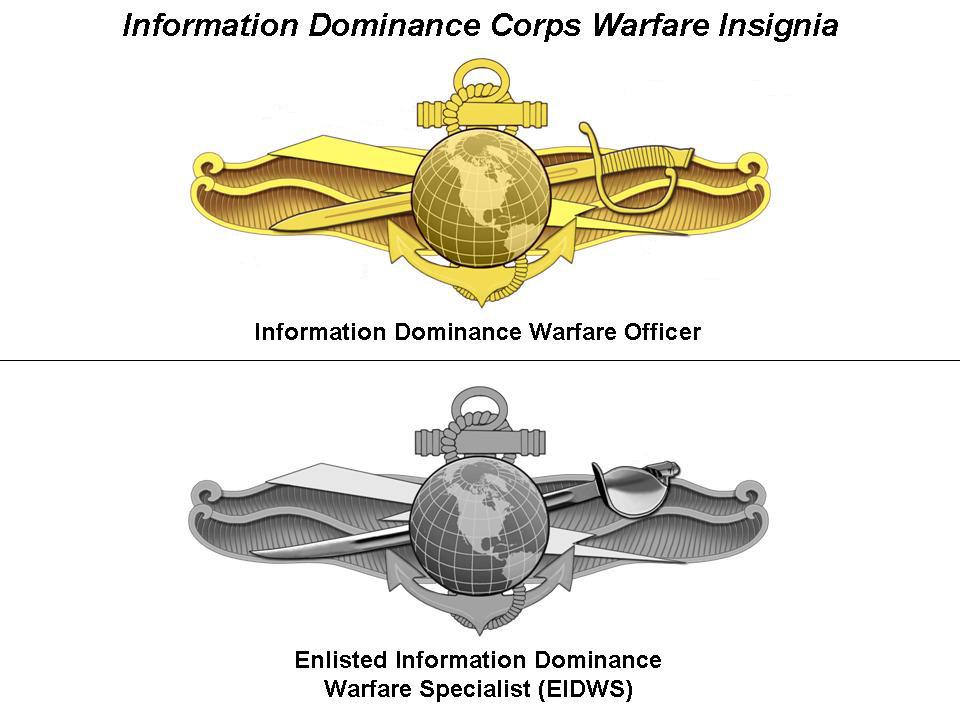
Sailors Earn Navy's Newest Warfare Pin

Seventy-one officers and three enlisted Sailors became the first group to receive the information dominance warfare pin during a ceremony at the Naval Observatory in Washington D.C., October 20, 2010.

The new qualification is designed to give members of the Information Dominance Corps a broader understanding of information dominance outside of their specialties.

"You really have to be able to understand, if you're in intelligence, what the cryptology folks are doing," said Master Chief Petty Officer Russell Smith, OPNAV staff command master chief. "You have to know how weather effects your operations. All these things combine together."

Friday, October 22, 2010

Everyone understand what this means?

When your bio is removed from the command website, you are finished. 

Command Master Chief

Under construction
 
CMC fired for fraternization. Command Master Chief (SW) Robert W. Stocklin was relieved following a Thursday afternoon administrative mast hearing before Amphibious Squadron 8 commander Capt. John Bruening.

Word to the wise:  Don't fraternize. 

Thursday, October 21, 2010

Harvard Business Review offers these tips for leaders - Help your Action Officers be more effective

Admiral Mike Mullen, chairman of the Joint Chiefs of Staff recognizes the Joint Staff Action Officers of the Month at the Pentagon, Washington, D.C., on March 10, 2010. (DoD photo by Mass Communication Specialist 1st Class Chad J. McNeeley/Released)
On a large Navy staffs around the world, there are countless distractions, threats, and roadblocks to getting work done. Superior Navy leaders take pride in shielding their Action Officers from these annoyances.

Harvard Business Review offers Navy leaders these three tips on ways to help their Action Officers focus on what matters:

  1. Show up on time. One of the biggest detractors from work is wasted time. This might be the time your Action Officers spend waiting for you to show up to meetings or to give needed direction. Being important doesn't give you permission to impede productivity.
  2. Stop the intrusions. Set aside time when your Action Officers can think and work, and not be expected to respond right away to phone calls, voicemail and e-mail.
  3. Let them have good fights. Don't avoid conflict. Make your Action Officers feel safe enough to speak their minds, even to you, so they have productive and creative disagreements.

Wednesday, October 20, 2010

Our Sailors ...

... are our greatest assets and it is our job as leaders to ensure every Sailor knows that we want them to succeed, and that we value their service, talent, skills, and dedication. We must make every effort to prepare our Sailors for success.

Caring about the well-being of our Sailors and their families will lead to professional success for our Sailors and ultimately the Navy. Invest in our future and lead on!

Hooyah!

MCPON West

Tuesday, October 19, 2010

Ours is the privilege...

..of leading the finest Sailors and civilians in the most capable and powerful maritime force in the world.  In challenging times it is easy to retrench, to become more conservative in approach.  We must look at this time as one of opportunity where boldness and innovation are the path to the future.  It is up to each of us to do so.

From his 2011 Guidance HERE.

Monday, October 18, 2010

CNO Guidance for 2011


An excerpt...

Achieve Decision Superiority.

The establishment of the Deputy CNO for Information Dominance (OPNAV N2/N6) and FLTCYBERCOM/C10F has elevated the role of information, cyber, space, and networks in our operations and investments. These organizations are supported by an Information Dominance Corps consisting of more than 45,000 Sailors and civilians from our existing intelligence, information professional, information warfare, meteorology/oceanography, and space communities. We have made significant progress in the information domain in the last year. I will continue to press in this area to ensure our networks and architectures are agile, responsive, and secure; that we are capable of leveraging information in all environments; and that we no longer limit our thinking to “information in warfare,” but fully develop the concept of “information as warfare.”
Way Ahead:
  • We will evolve Navy networks toward a model that is agile, relevant, secure and cost effective, while ensuring a seamless transition from NMCI to the Next Generation Enterprise Network (NGEN).
  • We will designate TENTH Fleet as our Cyber Claimant, BSO 60C, and give it the financial authorities necessary to quickly shift financial resources to combat the rapidly evolving cyber threat.
  • We will invest to enhance our ability to operate in anti-access, communications-denied environments.
  • We will institutionalize and mature the Information Dominance Corps and build its reputation as an elite cyber force.
The full text of Chief of Naval Operations Guidance for 2011 (CNOG 2011) is HERE.

CNO refers to the 2010 DoD Quadrennial Review which is available HERE.

Quadrennial Review Independent Panel Review Report is HERE.

CNO's Navy Vision for Confronting Irregular Challenges is HERE.

Navy's Total Force Vision for the 21st Century is HERE.